How to Mix and Match Outfits From the Clothes You Own
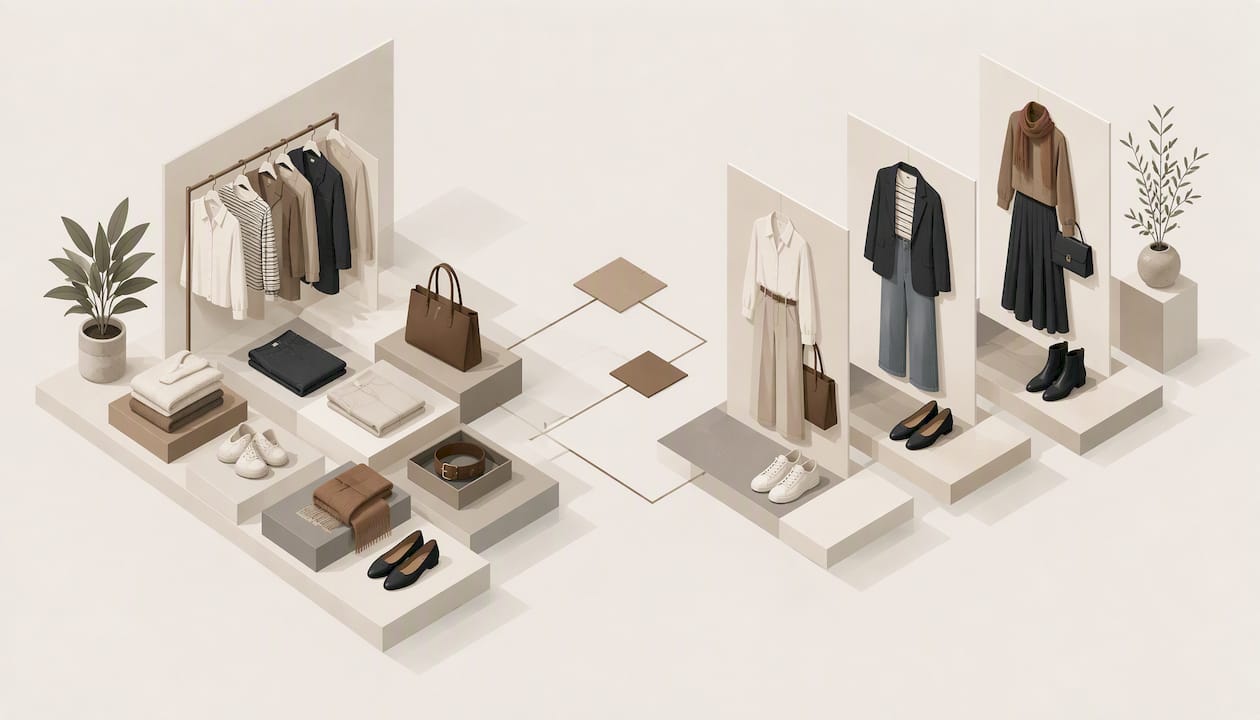
Mixing and matching outfits means combining separate pieces that work together, even though they were never sold as a set. The skill is not owning more clothes. It is knowing which pieces to pair, which one should lead, and which should stay quiet. This guide gives you a repeatable way to do it with the closet you already have.
TL;DR
- Choose one focal piece per outfit and keep everything else simple.
- Build around a small color family, and let patterns share at least one color.
- Balance texture: pair a dramatic or heavily textured item with a plain one.
- Sort your closet into categories, then test combinations by category, not by individual item.
- Use formulas (such as top, bottom, third layer) so getting dressed takes minutes.
Table of Contents
- What mix and match really means
- Start with a closet you can actually mix
- Pick one focal piece
- Mix colors without clashing
- Mix patterns the easy way
- Mix textures and layers
- Check the outfit with the seven-point rule
- Formulas that make mixing automatic
- Our perspective: mixing is a skill, not a talent
- Let Style To Cart do the sorting
- Common mix and match mistakes
- FAQ
- Sources
What mix and match really means
The dictionary definition is simple: mix-and-match clothing combines separate items that are compatible or complementary but do not have to come from the same set. The goal is a coordinated, attractive outfit built from interchangeable pieces.
That last word matters. A piece is only interchangeable if it plays well with several other things you own. A great dress that only works with one pair of shoes is a one-outfit item. A navy blazer that works with jeans, a slip skirt and trousers is a multiplier. Mixing and matching well is mostly about identifying your multipliers and building around them.
It also explains why people who own a lot of clothes still say they have nothing to wear. They own many one-outfit pieces and few connectors.
Start with a closet you can actually mix
Before you combine anything, you need to see what you have. Lay your clothes out by category: tops, bottoms, dresses, outer layers, shoes. For each category, ask two questions:
- Does this piece pair with at least three other things I own?
- Do I reach for it, or does it hang there?
Pieces that pass both are your working core. Pieces that fail the first test usually fail because of color, fit or style mismatch with the rest of the closet. If your closet feels scattered, a seasonal edit helps. Our fall closet cleanout method walks through how to sort what stays, what goes and what needs a partner.
Then look at color. Most closets that are hard to mix have too many unrelated colors competing. A wardrobe color palette gives you a short list of shades that all coordinate, so any top can meet any bottom without a debate.
The capsule shortcut
A capsule wardrobe is the most direct form of mix and match. Who What Wear describes it as a curated edit of pieces that can be mixed and matched into a range of outfits. You do not need to buy a new one. You can build it from your own closet, and we show how in our guide to a capsule wardrobe for women. If you wear plus sizes and have struggled to find pieces that are both flattering and flexible, the plus size capsule wardrobe guide focuses on fit first.
When you add to a capsule, add strategically. Oprah Daily creative director Adam Glassman’s wardrobe refresh advice is a good model: pieces that expand what you already own, such as a denim shirt with a pencil skirt, a blazer over varied outfits and a lightweight turtleneck under slip dresses. Each of those works with things already hanging in your closet.
Pick one focal piece
The most useful rule for mixing is also the simplest. Stylist Theodora advises choosing one major focal piece and keeping the rest of the outfit simple. Your eye needs somewhere to land. When three items all compete, the outfit looks busy even if every piece is nice.
A focal piece can be:
- A bold color, like a cobalt top or a rust skirt
- A strong print, like a floral midi or a striped shirt
- A dramatic shape, like a voluminous sleeve or a wide-leg trouser
- A textured or shiny item, like a sequin skirt or a chunky knit
Once you choose it, build the rest from your quiet pieces: neutral basics in a color that appears in or complements the focal piece.
A worked example
Say your focal piece is a printed skirt in green, cream and black. The quiet pieces could be:
- A cream tee or fitted knit (picks up the cream)
- A black blazer or cardigan (picks up the black)
- Flat shoes or boots in black or a neutral tan
Swap the skirt for dark jeans and the same cream top and black blazer still work. The print has gone, so now you might let the shoes or a green scarf take the lead. One outfit becomes three by changing only the focal point.
Mix colors without clashing
Color is where most people get stuck, because the rules sound abstract. Make it concrete with three approaches.
Neutral base plus one color. Wear neutrals (black, navy, white, gray, camel, denim) and let one piece carry a color. This is the safest and the most repeatable method.
Tone on tone. Combine different shades of one color, such as light blue and navy, or cream and tan. It looks deliberate and polished with almost no effort.
Two colors that share an undertone. Warm colors, such as rust and olive, tend to sit well together. Cool colors, such as lavender and gray-blue, do too. Mixing warm and cool is possible but is a more advanced move.
If you want ready-made pairings, our outfit color combinations guide gives ten you can wear without needing a color wheel.
Mix patterns the easy way
Pattern mixing looks risky but follows clear logic. InStyle’s pattern guide recommends pairing a large-scale print with a smaller-scale one and balancing a loud pattern with a subtler print. The scale difference stops the two prints from fighting.
The same guide says mixed patterns are easier to coordinate when they share a color scheme, and it suggests starting with two patterns rather than making the outfit overly busy.
Try these starter pairs:
| Pairing | Why it works |
|---|---|
| Wide stripe top and small floral skirt | Different scale, one shared color |
| Plaid blazer and thin-stripe tee | Bold on top, subtle underneath |
| Animal print scarf and solid outfit | One pattern, treated as a neutral accent |
| Polka dot blouse and pinstripe trousers | Both geometric, different scale |
If you are nervous, make the second pattern small, like a scarf, sock or bag. You get the effect without committing the whole outfit.
Mix textures and layers
Texture does what pattern does but more quietly. Theodora recommends mixing textures such as denim, cashmere and wool, while balancing a highly textured or dramatic item with a simpler piece. A chunky cable knit with a smooth satin skirt is a classic example: the contrast is the interest.
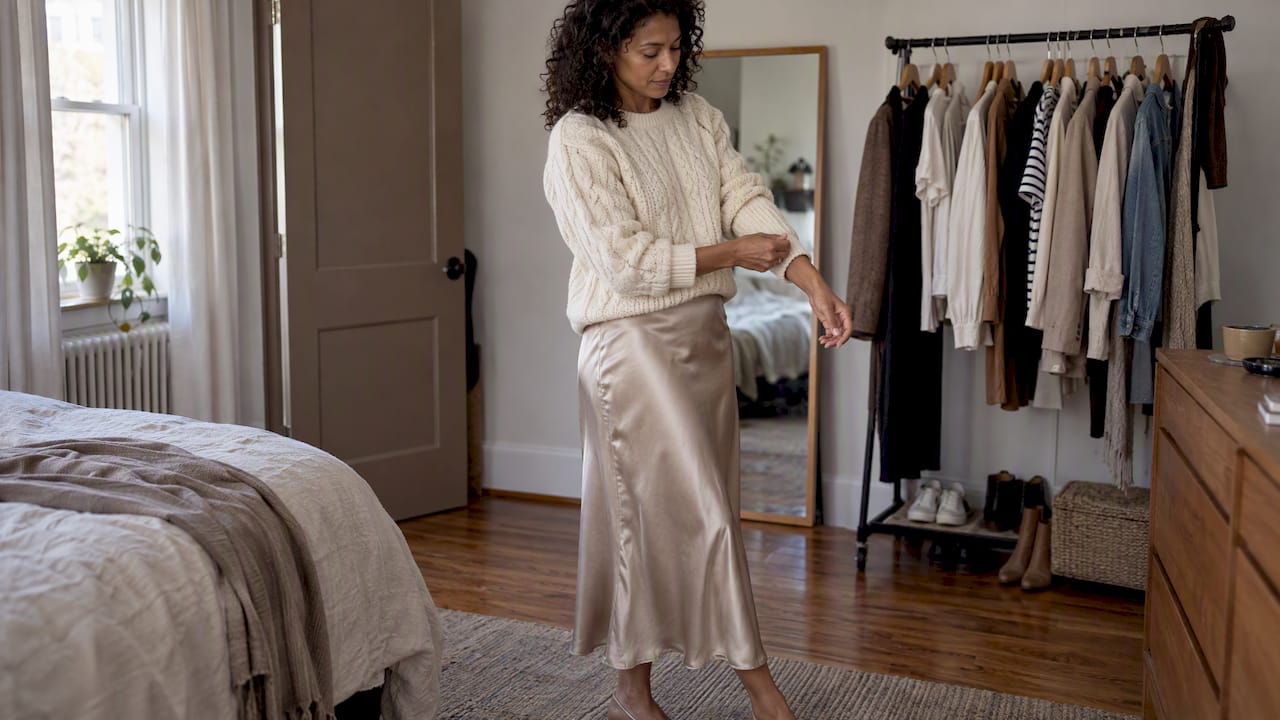
Layering adds another way to combine pieces. Stylist Sarah Slutsky Tooley says layering creates personality and depth, increases versatility, extends clothing’s useful life and helps outfits adapt to changing temperatures. She also recommends layering related outerwear categories, such as denim under leather, while making sure the proportions complement each other.
Proportion is the practical point. A few ways to keep it balanced:
- Fitted top with a roomy bottom, or the reverse
- A shorter jacket over a longer top, so the hems stagger
- One bulky layer at a time, not two
If your closet holds a lot of layering pieces, our day-to-night styling formula shows how a single base outfit can shift by swapping one layer and the accessories.
Check the outfit with the seven-point rule
If you want a quick test before you leave the house, try the rule that went viral on TikTok. InStyle’s explainer describes it as a visual checklist: basic items generally count as one point, statement or distinctive items as two, and the suggested target is seven or eight points, with six to ten as the broader range.
Here is how it plays out. Jeans (1), white tee (1), sneakers (1) and a plain jacket (1) total four, which reads as understated. Add a statement bag (2) and sunglasses (1) and you are at seven. Now swap the plain jacket for a printed one (2) and the bag for a basic one (1), and you are still at seven, with a different focal point.
The rule is a gut check, not law. Its value is that it reminds you an outfit usually needs a bit of something, but not too much of everything.
Formulas that make mixing automatic
Once you know your multipliers, formulas remove the guesswork. Each formula has slots, and you fill them from your closet.
| Formula | Slots | Example |
|---|---|---|
| Base plus layer | Tee, trousers, blazer | White tee, camel trousers, navy blazer |
| Dress plus structure | Dress, jacket, flat shoe | Slip dress, denim jacket, loafers |
| Tone on tone | Top, bottom, accent | Cream knit, tan skirt, brown belt |
| Focal piece | One statement, two quiet | Printed skirt, solid top, plain cardigan |
| Uniform | Same silhouette, new color | Knit and straight pants in rotating shades |
Our outfit formulas article goes through twelve looks that you can copy from your own closet.
Formulas also solve the morning problem. Who What Wear notes a balanced capsule reduces morning stress by giving you a roster of pieces that can be mixed and matched at short notice, and it frames the approach as useful for both daily dressing and light packing. Its feature on stylist Nicole Chavez offers a reliable uniform, a polished travel look and a grab-and-go office look as templates for days with little time to plan.
Mixing for work
Work is where interchangeable pieces earn their keep. Jamie Mizrahi’s capsule guide emphasizes interchangeable elevated staples that work with clothes already owned and can be dressed up or down for the office, errands or date night. For a weekday system, see our five-minute work wardrobe method. For specific occasions, our guide to meeting outfits for women goes step by step.
Our perspective: mixing is a skill, not a talent
We have spent more than 20 years in wardrobe styling, and the same thing happens in nearly every closet. Women do not lack clothes. They lack a way to see the clothes as a system. They look at each item alone, decide it does not go with anything, and buy another piece to fix the problem. The new piece usually has the same problem.
Our approach comes from both styling and teaching. Wendy’s background in education shapes how we explain this: we would rather you understand why an outfit works than memorize a rule. Once you understand that a focal piece needs quiet partners, or that two patterns need a shared color, you can build outfits we have never seen.
The other thing we notice is that the best outfits are rarely the most inventive. They are the ones you can repeat, adjust and enjoy without effort. A handful of reliable formulas, a clear color family and a closet you can see will beat a hundred pieces and no plan.
Start with what you own. Find your multipliers. Fill the gaps deliberately, not on impulse.
— Wendy
Let Style To Cart do the sorting
Doing this by hand works, but it takes time: photographing, sorting, testing pairings, spotting gaps. Style To Cart is the platform we built to turn our styling consultations into software. It lets you virtually assess your closet, identify wardrobe gaps, discover new ways to wear pieces you already own, and shop more strategically.

If you want to see how it works, start at the Style To Cart home page, or read how a stylist became a software founder to learn why we built it.
Common mix and match mistakes
Too many focal points. If you are wearing a print, a bold color and a statement bag, pick one to lead.
Matching everything exactly. Coordinated is not identical. A top and shoes in the exact same shade can look stiff; a related shade looks intentional.
Ignoring proportion. Two oversized pieces together tend to swallow you. Balance volume with something fitted.
Buying for a single outfit. Before you buy, name three things at home it would pair with. If you cannot, skip it. This matters for trends too: our fall trends worth buying guide separates the pieces that mix well from the ones that do not.
Keeping clothes you never wear. Unworn pieces clutter the closet and hide the pieces that can be combined.
FAQ
What is meant by mix and match outfits?
It means building an outfit from separate pieces that complement each other, rather than wearing a matching set. The pieces do not need to come from the same brand or collection. They simply need to share color, proportion or style so that together they look coordinated.
How do I mix and match my clothes if I have a small wardrobe?
Start with a neutral base, such as jeans, trousers, tees and a blazer, and add one or two pieces in a color you love. A small, color-consistent wardrobe mixes more easily than a large, scattered one. Add pieces that pair with at least three things you already own.
Can I mix patterns without looking busy?
Yes. Keep one pattern large and the other small, and make sure they share at least one color. If you are unsure, begin with just two patterns and keep everything else solid.
How many outfits can I make from a few pieces?
It depends on how interchangeable the pieces are, not how many there are. Ten pieces that all coordinate can produce far more outfits than thirty that do not. Count combinations by category, for example three tops, three bottoms and two layers, to see your real total.
What should I do if an outfit feels off but I cannot say why?
Check for one focal piece first. If two items are competing, quiet one down. Then check proportion and color: a fitted piece to balance a roomy one, and a shared color to tie things together.
Sources
- MIX-AND-MATCH definition and meaning, Collins English Dictionary
- How to Put Outfits Together, According to Celeb Stylists, InStyle
- How TikTok’s 7-Point Rule of Fashion Can Make Getting Dressed Easier, InStyle
- How to Mix Patterns and Prints: 7 Easy Outfit Ideas, InStyle
- How to Layer Clothes Like a Pro, Harper’s Bazaar
- How to Build a Casual Capsule Wardrobe, Who What Wear
- Adam Glassman’s Style Sheet: Style Refresh Fall 2023, Oprah Daily
- The Only Spring Capsule Wardrobe You Need, Who What Wear
- How to Build a Chic Summer Capsule Wardrobe, Who What Wear
- 3 Fall Quince Outfits Styled by Celebrity Stylist Nicole Chavez, Who What Wear
Recommended
About Wendy
Wendy Pilch is an award-winning wardrobe stylist, entrepreneur and Founder & CEO of Style To Cart. After more than 20 years of helping women build wardrobes and define their personal style, Wendy is bringing that experience to fashion technology.