Meeting Outfits for Women: What to Wear, Step by Step
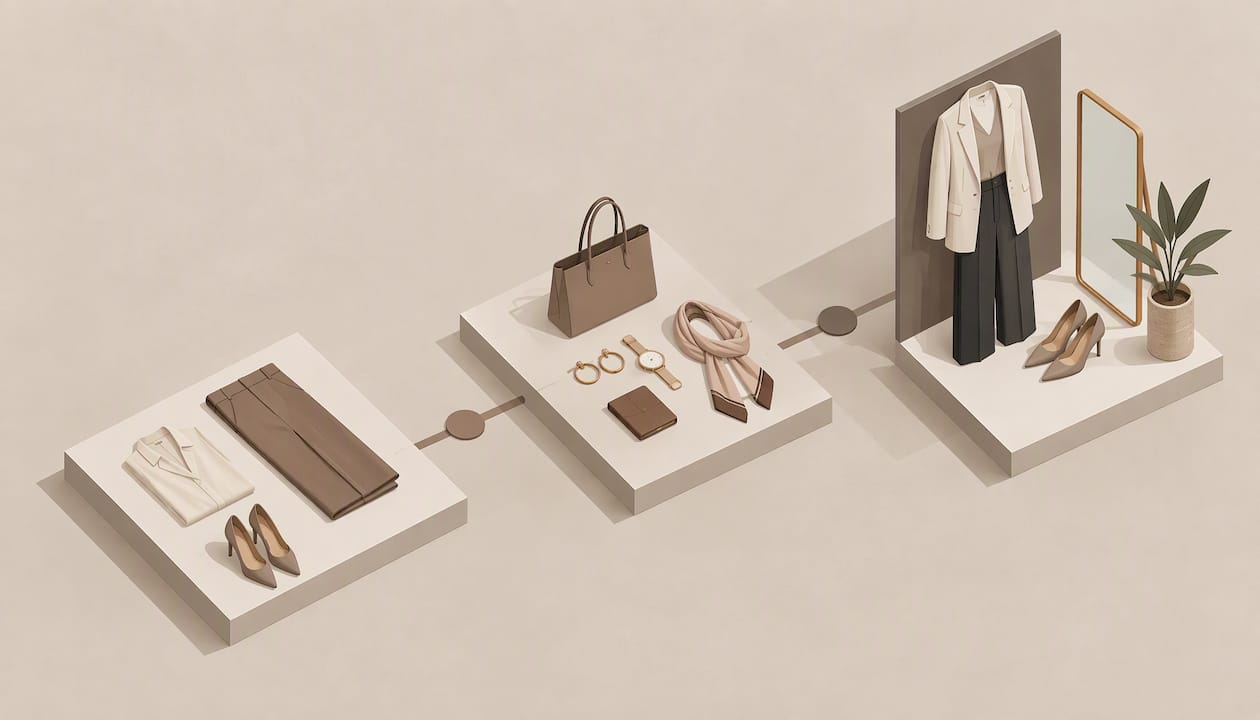
The best meeting outfit is one that fits the room, fits your body while seated, and needs no thinking on the morning itself. Start with the dress code of the meeting (not the company), pick a structured top layer in a clean neutral, and check fit sitting down. Everything else is detail.
Below you will find outfit formulas for five common meeting types, a small capsule list that covers most of them, the color and fit rules that matter on camera, and how to check what you already own before you buy anything new.
TL;DR
- Match the meeting, not your job title: a client pitch, a team stand-up and a board review each call for a different level of polish.
- A blazer, tailored trousers, a structured midi dress and a few good blouses will cover most meetings. One capsule guide suggests one quality blazer, two blouses, tailored trousers, a skirt and a structured midi dress.
- Fit beats trend. Sit down in the outfit before you commit: nothing should gap, pull or ride up.
- On video, the upper half does the work. Navy, cream and olive read well on camera; pure black can look harsh and pure white can blow out.
- You do not need new clothes first. Audit what you own and find the gap before you shop.
Table of Contents
- Start with the meeting, not the closet
- Everyday team meetings: polished, but easy
- Client meetings and presentations
- Board meetings and executive reviews
- Video meetings: dress the top half for the camera
- The capsule that covers most meetings
- The details that signal care
- Dress codes are changing
- Our perspective: build the system, not the outfit
- Audit your closet before you shop
- A simple way to plan your week
- Mistakes that undercut a good outfit
- FAQ
- Sources
Start with the meeting, not the closet
Most outfit stress comes from skipping one question: who is in the room, and what will they be wearing? A useful shortcut is to sort every meeting into one of three levels, which mirrors how many employers write their own policies. One state agency dress code, for example, recognizes three categories: business professional, business casual and casual.
Here is how that plays out for the meetings women most often ask about.
| Meeting type | Level | Outfit formula |
|---|---|---|
| Internal team meeting | Business casual | Tailored trousers, a knit or silk-feel blouse, loafers or flats |
| Client or new-business meeting | Business professional | Blazer, matching or coordinated trousers or skirt, a clean shell or blouse |
| Board or executive review | Business professional, high stakes | Suit or a structured sheath dress in suiting-quality fabric |
| Video call | Business casual to professional | Strong top half: blazer or structured knit in navy, cream or olive |
| Conference or offsite | Varies by industry | Layers: blazer plus a cardigan or wrap, comfortable shoes |
When you are not sure, ask the organizer, or look at how people dressed in the last event you can see photos of. Dressing one notch above the most polished person you expect is a safe default, and it is easy to dial down by taking off a blazer.
Everyday team meetings: polished, but easy
For weekly meetings with people you know, you want an outfit you can wear for hours, walk in and still look put together at 4 p.m.
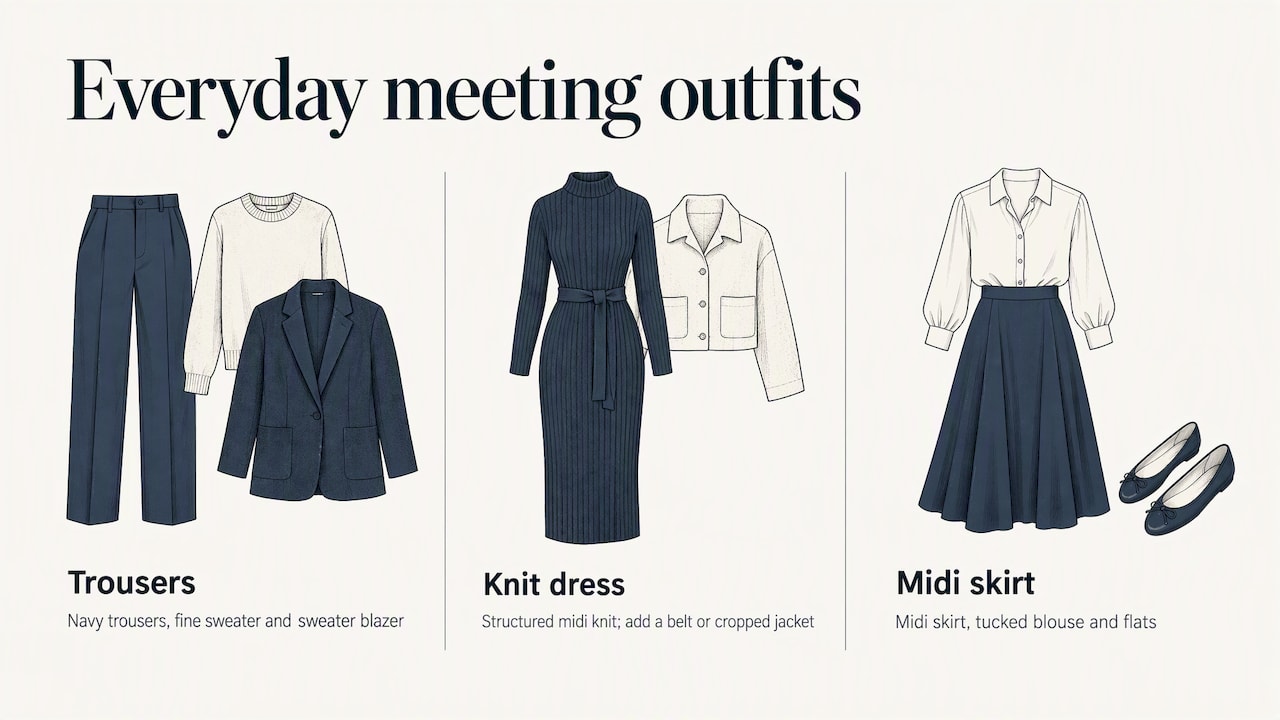
Formula one: trousers and a layer. Straight or wide-leg trousers in navy, charcoal or camel, a fine-gauge sweater or a crisp blouse, and a sweater blazer on top. Add loafers or low block heels.
Formula two: the knit dress. A midi knit dress with some structure (a thick ponte or a dense knit, not a clingy jersey) plus a belt or a cropped jacket. It is a single piece, so there is nothing to coordinate.
Formula three: skirt and tucked top. A midi skirt with a tucked-in blouse and flats. If your office is casual, a tailored skirt in a dark neutral can take a fitted tee.
Can you wear jeans?
It depends on your workplace, and policy language varies. Some institutions state plainly that business casual means slacks, not jeans: Southern Utah University’s career guidance, written in 2017, is one example, and it also still lists nylons, which many workplaces have since dropped. If jeans are acceptable where you work, choose a dark wash with no distressing, a clean hem and a straight or slightly wide leg, then pair them with a blazer and a polished top. A conference outfit guide from Corporette suggests dark jeans only for creative-industry events, with a polished top and a statement jacket.
If you wear a graphic tee to a casual meeting where it is welcome, treat it like a design element, not the whole outfit. Layer it under a blazer or a cardigan and keep the rest quiet. These outfit formulas for styling graphic tees show how that layering can work.
Client meetings and presentations
When you are the person being evaluated, aim for credible and memorable, not flashy. Research summarized by Forbes points out that people judge whether you “look the part” quickly, and that this impression can influence hiring and advancement even though it has no proven link to actual performance. That is not fair, but it is useful to know. The same piece makes clear that the goal is not expensive or trendy clothing.
Try this formula:
- A blazer or tailored jacket that sits cleanly on the shoulders.
- A shell, silk-feel blouse or fine knit underneath, with a neckline you will not have to adjust.
- Tailored trousers or a pencil or A-line skirt that clears your knee when you sit.
- Closed-toe shoes you can walk and stand in comfortably.
- One simple accessory: a watch, small earrings or a scarf, not all three.
If you are presenting standing up, pick a jacket with room for your arms to move and a top that stays in place when you gesture. Test it by reaching forward, lifting both arms and sitting down.
Board meetings and executive reviews
Board meetings call for the most formal end of your wardrobe, and often long hours sitting at a table. That changes what “good” means. A board meeting guide from Lindsay Nicholas New York notes that a structured sheath or shift dress can carry as much authority as a suit when the fabric is good, such as suiting wool or crepe, and it keeps its shape. The same piece stresses fit over trend: a garment that gaps, pulls or rides up when you sit is a problem.
A few board-ready combinations:
- The suit. Navy or charcoal, with a shell or fine blouse. A matching suit is simplest, but a jacket and trousers in slightly different tones of the same family also look deliberate.
- The sheath plus jacket. A knee-length sheath in a dense fabric, with a tailored jacket you can keep on or remove.
- Tailored trousers with a silk-feel blouse and long blazer. Slightly softer, still senior.
Color does quiet work here. The capsule guide mentioned earlier calls navy, charcoal, camel and black the most effective bases for professional authority. Keep jewelry and fragrance minimal in a small room.
Video meetings: dress the top half for the camera
Hybrid work means many first impressions happen on a screen in a few seconds. The same meeting outfit guide recommends a strong upper-body silhouette and clean colors such as navy, cream or olive, and warns that pure black can look harsh and pure white can blow out on camera.
Practical adjustments:
- Choose a structured shoulder: a blazer, a structured knit or a top with a defined neckline.
- Skip busy small patterns, which can shimmer on video.
- Test with a quick camera check in the lighting you will actually use, including the time of day.
- Keep necklaces simple so they do not tap against a microphone or clash with a headset.
- If you may need to stand up unexpectedly, wear bottoms you would be comfortable being seen in.
The capsule that covers most meetings
You do not need thirty options. The capsule approach recommends a small rotation: one high-quality blazer, two blouses, tailored trousers, a skirt and a structured midi dress. Built in neutrals, those pieces mix into many outfits and pack lightly for business travel.
Here is how five pieces become a week of looks:
| Day | Combination |
|---|---|
| Monday | Trousers, blouse one, blazer |
| Tuesday | Skirt, blouse two, no jacket |
| Wednesday | Structured midi dress, blazer |
| Thursday | Trousers, blouse two, a cardigan in place of the blazer |
| Friday | Skirt, blouse one, blazer, flats |
Swap your own colors in. If you work in a conservative field, lean navy and charcoal. If you work somewhere more creative, olive, rust or a patterned blouse can sit in the same slots.
The details that signal care
It is tempting to think a better meeting outfit means a bigger budget. The Forbes piece on appearance argues the opposite: the value lies in consistency, meaning fit, condition and intentionality. Wrinkles and loose threads suggest you are not paying attention, and the reverse suggests you are.
A five-minute check before you leave:
- Steam or press anything with creases, especially collars and the back of trousers.
- Check hems and buttons. Loose threads, missing buttons and fraying hems are easy fixes.
- Sit and reach in front of a mirror. Nothing should gap at the bust, ride up at the hip or pull across the back.
- Look at your shoes. Scuffs and worn heels show.
- Empty your pockets and bag so nothing bulges or rattles.
A tailor is often the best money you can spend: hemming trousers or taking in a jacket makes a mid-priced piece look far more expensive.
Dress codes are changing
It is also worth knowing that old, gendered rules are fading. Some commentators note that requiring women to wear skirts or nylons may conflict with anti-discrimination law such as Title VII of the Civil Rights Act, and modern guidance leans toward professionalism, cleanliness and fit. If your employer’s policy asks for something you believe is discriminatory, raise it with HR, and if that does not resolve it, consider speaking to an employment attorney. For most of us, the practical takeaway is simple: trousers, dresses and skirts are all acceptable when they are tailored and neat.
Our perspective: build the system, not the outfit
After more than 20 years of wardrobe styling, we have noticed that women rarely lack clothes for meetings. They lack a clear picture of what they own and how the pieces work together. The same blazer sits unworn because it “only goes with one thing,” while a new one is bought to solve a problem the closet already solved.
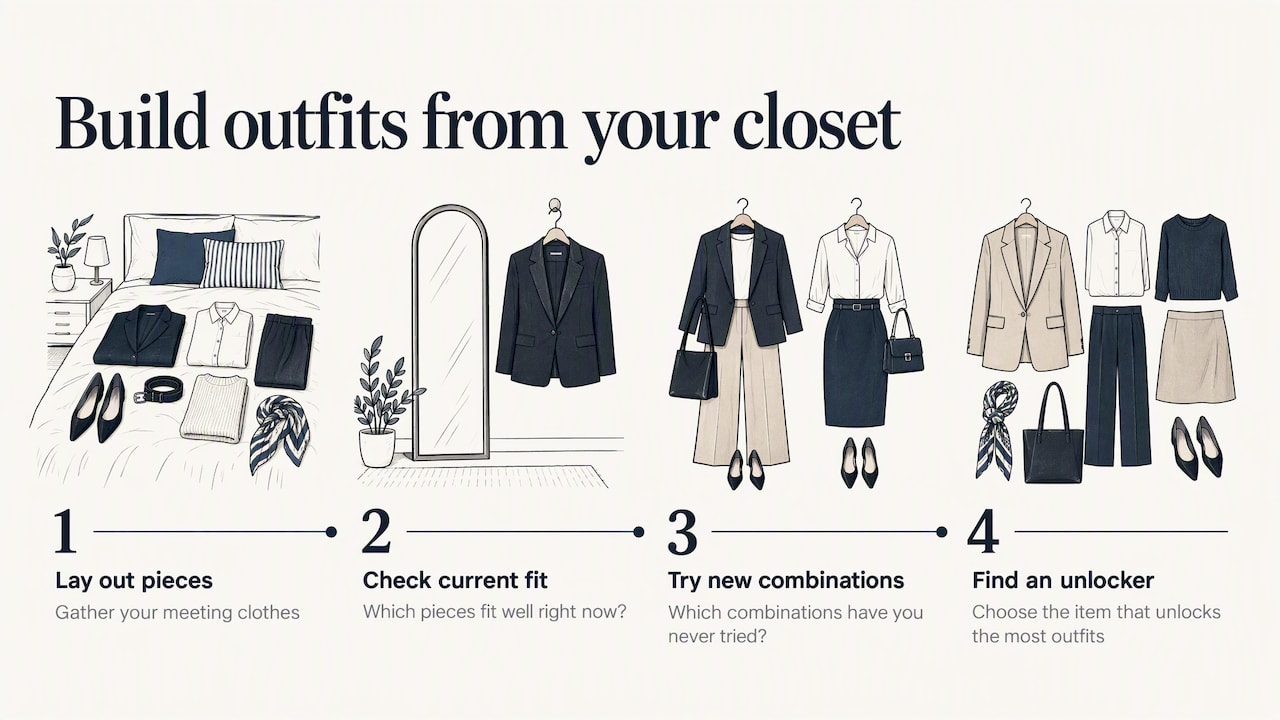
That is why we tend to start with the closet, not the store. Lay out your meeting pieces, and ask three questions. Which pieces fit well right now? Which combinations have I never tried? What single item would unlock the most outfits? Often the answer is a layer, such as a second blazer in a different neutral, not a whole new look.
We also believe in teaching, not dictating. Wendy’s background in education shapes how we explain fit and proportion, so you can make your own decisions the next time you shop. A meeting outfit should make you feel capable, and that comes from knowing why it works.
— Wendy
Audit your closet before you shop
If you want to put this into practice, Style To Cart is built for exactly this job. It is a fashion technology platform that lets you virtually assess your closet, spot gaps, find new ways to wear what you already own and shop more strategically. It takes the kind of personalized consultation Wendy has done for two decades and makes it available as software. You can see how it works at Style To Cart, or read about the thinking behind it in Wendy’s story from stylist to software founder. For more styling ideas, browse The Edit.
A simple way to plan your week
Busy professionals tend to decide outfits on the morning of a meeting, which is when decisions are worst. Try this routine:
- Sunday: check your calendar and label each meeting by level (casual, professional, high-stakes).
- Assign outfits: pull one outfit per level and hang them together.
- Prep the details: steam, check hems, line up shoes.
- Keep a backup: a spare blazer and a pair of neutral flats at the office save you from spills and surprise invitations.
- Note what worked: a quick photo of each outfit helps you repeat winners.
This also shows you patterns. If you keep reaching for the same two pieces, those are your workhorses, and it may be worth investing in better versions of them.
Mistakes that undercut a good outfit
- Dressing for the wrong audience. A client meeting with a conservative firm is not the same as a startup stand-up.
- Choosing new, untested shoes. Blisters change your posture and your mood.
- Ignoring the room’s temperature. Conference rooms can be cold, so carry a cardigan or wrap, as Corporette also advises for conference layering.
- Wearing something that needs constant adjusting. A slipping strap or a gaping button pulls your attention away from the meeting.
- Treating black as automatically safe. It can work in person, but on camera it can look harsh.
- Buying trends for meetings. Classic shapes last longer and look intentional for years.
FAQ
What should a woman wear to a business meeting?
Tailored trousers or a knee-length skirt or dress, a polished top and a blazer or structured layer are a reliable base. Choose neutrals such as navy, charcoal, camel or cream, and check that everything fits while you are seated. If the meeting is with clients or executives, go one notch more formal than your usual day.
What should I wear to a board meeting as a woman?
Choose a suit or a structured sheath or shift dress in a high-quality fabric such as suiting wool or crepe, as one board meeting guide advises. Prioritize fit when sitting for hours, and keep accessories minimal. A jacket you can keep on or take off gives you flexibility.
Can I wear jeans to a meeting?
Only if your workplace allows it, because policies differ and some state that business casual excludes jeans. If they are fine, pick dark, clean, unripped denim and dress them up with a blazer and a polished top. For a client meeting or board review, choose trousers instead.
What colors look best on video calls?
Navy, cream and olive read cleanly on camera, while pure black can look harsh and pure white can blow out, according to this meeting outfit guide. Test your outfit in your own lighting, because every room and webcam behaves differently.
Sources
- Forbes: ‘Looks Maxxing’: How The Silent Currency Impacts Your Career
- Vlaluna: 20+ Stylish Meeting Outfits Women You’ll Love to Wear
- Lindsay Nicholas New York: What to Wear to a Board Meeting
- Engage for Success: Dress Codes in the Workplace and Their Impact on the Professional Image
- Corporette: What to Wear to a Conference in 2026
- Southern Utah University: What to Wear for Professional Dress Codes
- Georgia Department of Human Services: Dress Code Guidelines
About Wendy
Wendy Pilch is an award-winning wardrobe stylist, entrepreneur and Founder & CEO of Style To Cart. After more than 20 years of helping women build wardrobes and define their personal style, Wendy is bringing that experience to fashion technology.