Weekly Outfit Planning: A Simple System That Works
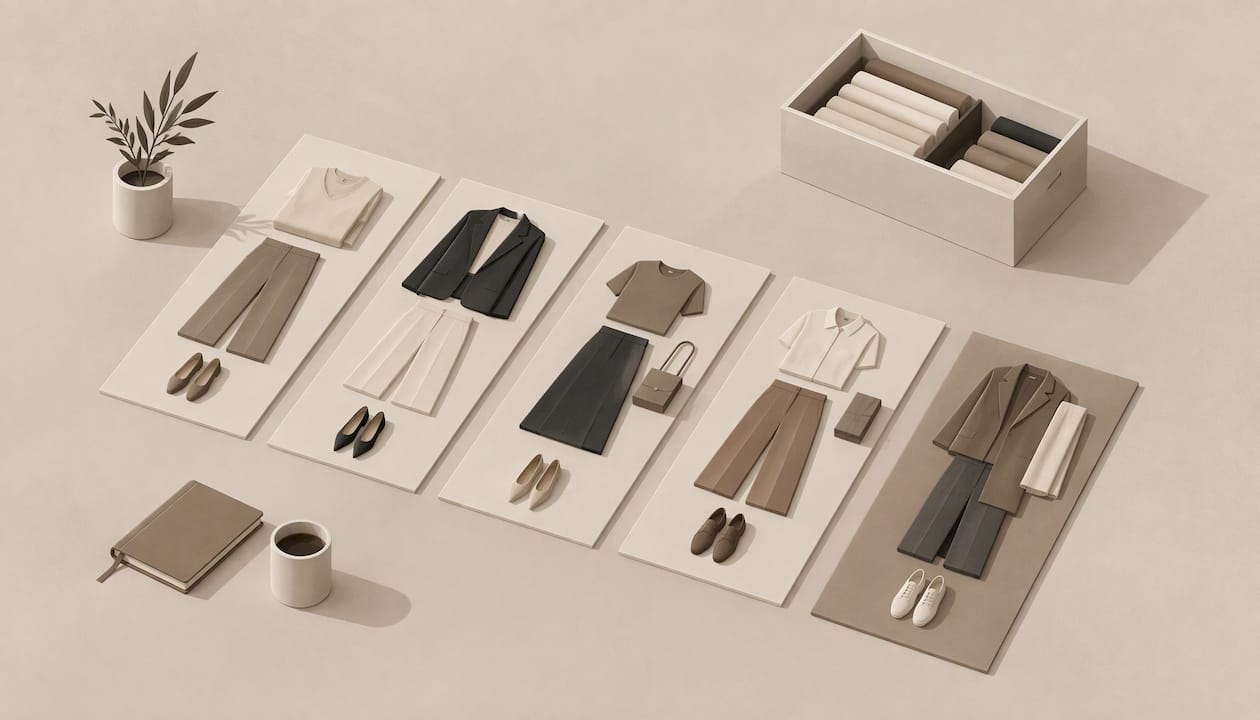
Weekly outfit planning means deciding what you will wear for the next seven days at one calm moment, instead of making that choice in front of the closet at 7 a.m. You check the forecast and your calendar, pick complete outfits from clothes you already own, and keep a backup for the day that goes sideways. It takes 20 to 30 minutes once you have a routine, and it pays back every morning.
Below is the routine we recommend, a planner template you can copy, and how to adapt it for a work week, a trip or fashion week.
TL;DR
- Plan on the day you will actually stick with. Sunday evening is common, but consistency beats tradition.
- Start with the weather and the calendar, then solve your most constrained day first and build the rest around it.
- Give each day one anchor piece, one adjustment (a layer or shoe) and one backup trigger. You are moving the decision, not removing choice.
- Plan complete outfits, accessories included, and try them on once. Photograph them so the plan is easy to follow.
- If you keep running out of options, the problem is usually gaps in your closet, not a lack of clothes.
Table of Contents
- Why planning outfits a week ahead works
- The seven-step weekly routine
- The five-field planner that keeps it short
- Build the week around the weather
- Plan the pieces, not just the clothes
- Planning for a trip
- Planning for fashion week
- Our perspective: plan the week, then fix the closet
- When a paper plan is not enough
- Common mistakes to avoid
- A 30-minute first session
- FAQ
- Sources
Why planning outfits a week ahead works
Most morning outfit stress is a timing problem. You are choosing while rushed, half awake and unsure what the day holds. Planning moves that decision to a moment when you can see the whole week at once.
It also changes how you see your closet. When you lay out five days together, you notice that one blazer carries three outfits and that a pair of trousers never gets worn because nothing goes with it. That is useful information you never get from daily guesswork.
One caution from the research we reviewed: the goal is not to generate endless looks or lock yourself into a rigid schedule. A good planner reduces decisions rather than recording every garment, which means the plan should leave you room to change your mind.
The seven-step weekly routine
This sequence follows the routine laid out in a weather-based week planner, with the practical order a stylist would use.
- Review the next seven days of weather. Look at temperature, rain, wind and the feels-like number, not just the high. A 55-degree morning that climbs to 75 by afternoon needs a layer, not a single heavy piece.
- Mark what is on your calendar. Note the workdays, presentations, client lunches, dinners, travel and any dress codes. A day with a flight and an evening event is very different from a desk day.
- Solve the hardest day first. Pick the day with the most constraints, say a morning presentation, a commute on foot and a dinner afterward. Build that outfit before anything else. The easy days will fall into place around it.
- Check laundry and availability. The best outfit on paper is useless if the shirt is in the hamper or at the dry cleaner. Confirm every piece is clean, pressed and wearable.
- Choose complete outfits. Include shoes, a bag, jewelry and outerwear. Half-planned outfits are where the 7 a.m. scramble comes back.
- Try on anything you are unsure about. A new pairing that looked good in your head may pinch, gape or clash. Find out on Sunday, not Wednesday.
- Schedule or photograph the plan. A phone photo of each look, or a simple note in your calendar, is enough. You want to open it and just get dressed.
The same source notes that Sunday evening is the usual choice but that the best day is the one you will consistently use. If your Sundays are chaotic, plan Friday afternoon or Monday at lunch.
The five-field planner that keeps it short
If you have ever abandoned a planner because it asked for too much, this format is for you. For each day, fill in five short fields. It is adapted from the five-field day structure in this planning guide.
| Field | What to write | Example |
|---|---|---|
| Day requirement | The one thing the outfit must handle | Client meeting, then a 15-minute walk |
| Anchor piece | The item the outfit is built around | Navy blazer |
| One adjustment | A layer, shoe or accessory that adapts the look | Swap loafers for ankle boots if it rains |
| Backup trigger | The specific condition that makes you switch | Forecast shows rain after 60 percent chance |
| Backup outfit | What you wear instead | Trench, dark trousers, boots |
The anchor, the adjustment and the backup trigger are what make the plan resilient. You are not choosing three outfits a day. You are choosing one and deciding in advance what would change it.
A sample work week
Here is how that looks for a busy professional with an ordinary office schedule. Swap in your own pieces.
- Monday (team meeting, in-office): Anchor: gray trousers. Adjustment: add a cream knit if the office is cold.
- Tuesday (presentation, the hardest day): Anchor: the navy blazer you trust. Adjustment: comfortable heels or flats depending on the room. Backup: a dress you have already tested.
- Wednesday (remote, one video call): Anchor: a good blouse that looks sharp on camera. Comfortable bottoms are fine.
- Thursday (client lunch): Reuse Tuesday’s blazer with a different top and the trousers from Monday. Repeating a versatile piece is a feature of a plan, not a failure.
- Friday (office, dinner after): Anchor: a midi skirt. Adjustment: swap the day shoes for dressier ones in your bag.
Notice that five days use only two jackets, two bottoms and a few tops. That is what mixing and matching looks like when you plan it on purpose.
Build the week around the weather
Treat weather as a constraint, not an afterthought. Forecast changes can make a good-looking plan unusable, especially if you commute on foot, deal with rain or wind, or face big temperature swings across the day.
A few habits that help:
- Check the forecast twice. Once when you plan, and once the evening before. Your backup trigger tells you what to do if it changed.
- Plan in layers. A top, a middle layer and outerwear let you adapt to a cold morning and a warm office without changing the whole outfit.
- Think about footwear first on wet days. Shoes are the piece most likely to ruin a plan when it pours.
- Look at the hours you are outside. Your 8 a.m. commute matters more than the afternoon high if you spend the afternoon indoors.
Plan the pieces, not just the clothes
An outfit is more than garments. The bag, the hat, the scarf and the jewelry often decide whether a simple look feels finished. Pull those together at the same time as the clothes, and try the full look once, with accessories, in front of a mirror. If you are shopping for pieces to round out a look, hats, bags and other accessories are worth browsing with your existing outfits in mind, so you buy things that work with several looks.
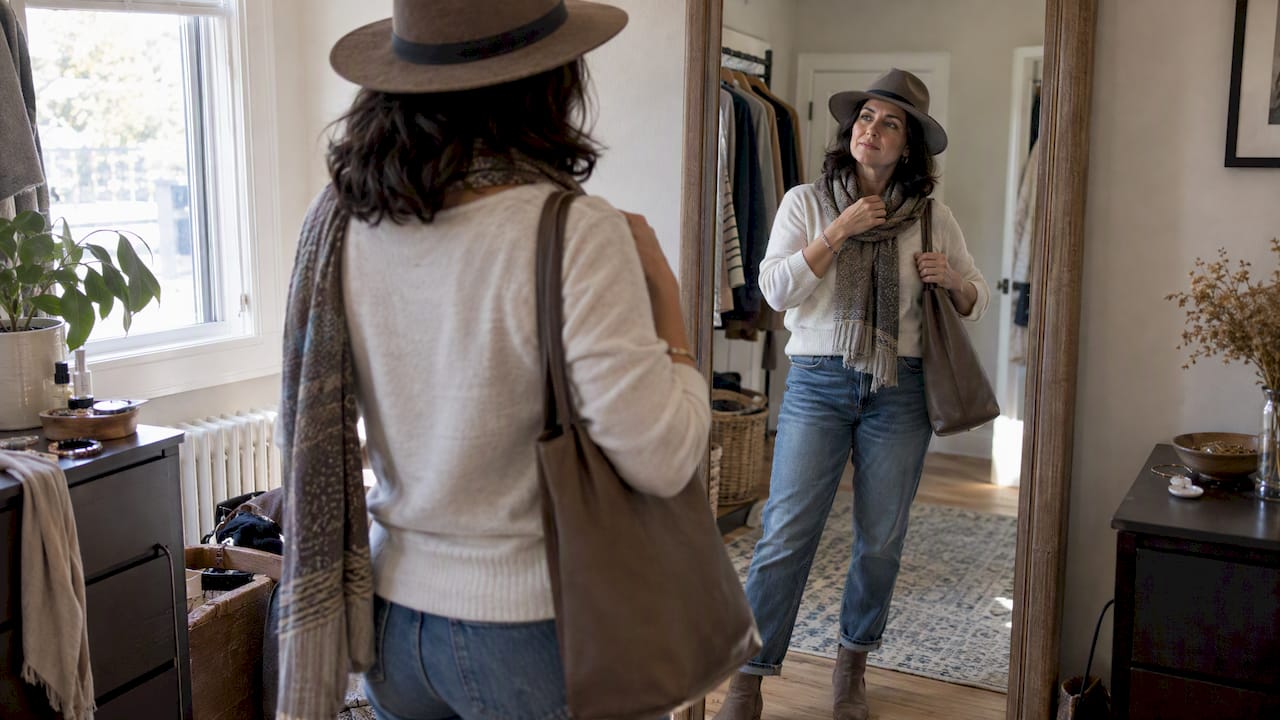
A small tray or hook near the door for the week’s accessories keeps everything together. Do the same for makeup and beauty: decide the week’s routine, such as a quick weekday face and a fuller one for the dinner night, and set out what you need.
Planning for a trip
When readers ask how much clothing to pack for a week, the honest answer is that there is no universal number. The right amount depends on trip length, laundry access, climate, activities and whether pieces can be remixed.
So plan outfits, not item counts:
- List each day’s activities and dress-code needs.
- Build outfits that share pieces: one jacket, two bottoms and several tops can produce a week of looks.
- Repeat versatile layers rather than packing a new top for every day.
- Pack weather contingencies, such as a compact umbrella or a waterproof layer, based on the forecast for the days you travel.
- Roll or pack each outfit together so you are not hunting for a belt at the destination.
The same logic applies to a long weekend or a conference. The fewer decisions you leave for the hotel room, the better.
Planning for fashion week
If the keyword brought you here because you are heading to a fashion week, the principle holds, with higher stakes. Professionals describe the same pattern: a clear point of view, plus practicality for long days on your feet.
Vogue’s editors’ NYFW list leans on warm layers, coats, practical boots and a bag big enough for chargers and notes. Stylist Zerina Akers describes running her fashion week schedule from a color-coded spreadsheet, which is a planner by another name. For packing, Vogue Scandinavia’s Copenhagen Fashion Week packing feature shows a stylist visualizing complete looks before she leaves.
The takeaway is the one from your office week: build on strong basics, outerwear and comfortable shoes, then add one expressive piece per look instead of buying a new statement item for every day. Try each look on with its accessories, photograph it, and pack it as a unit with a backup.
Our perspective: plan the week, then fix the closet
We have spent more than 20 years styling women in their own wardrobes, and the same pattern shows up again and again. Women say they have nothing to wear while standing in front of a full closet. Almost never is the issue effort or taste. It is that nobody has shown them how their pieces work together, or what is genuinely missing.
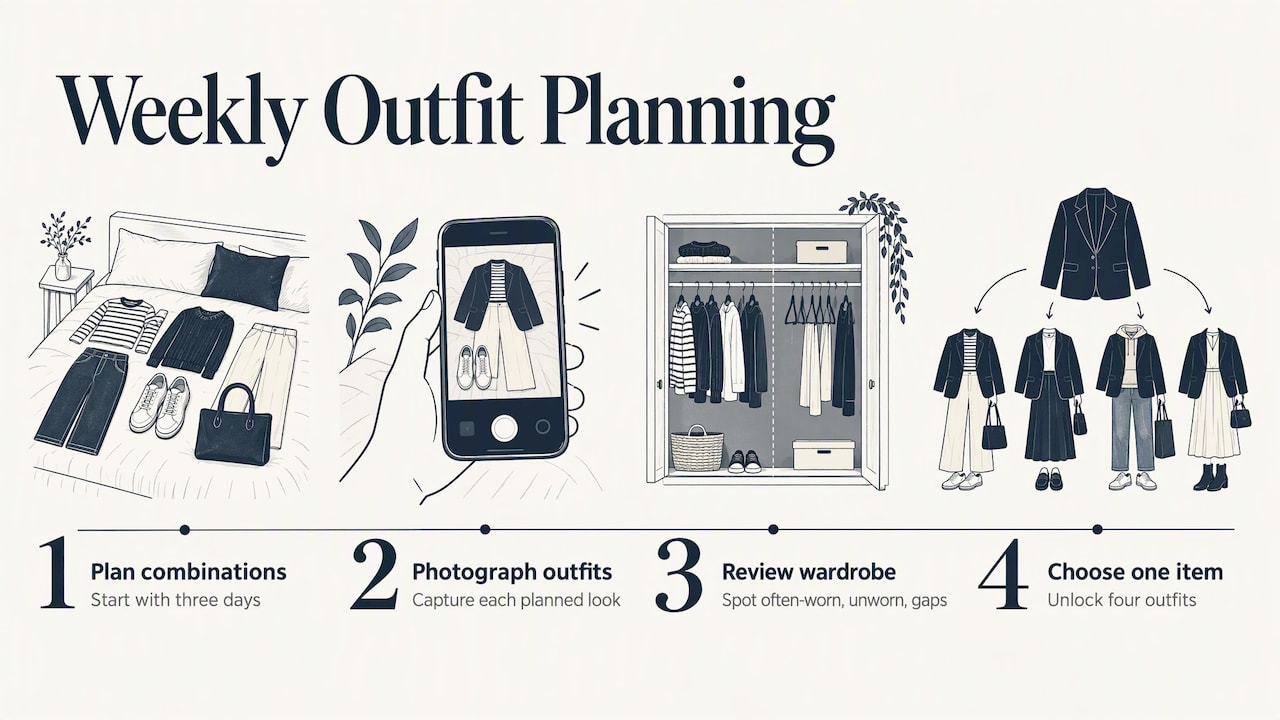
That is why we think weekly planning is the best entry point into a better wardrobe. A plan forces you to see your clothes in combinations. After two or three weeks you learn which pieces do the heavy lifting, which ones never leave the hanger, and where the real gaps are. Then shopping becomes strategic: you buy the one item that unlocks four outfits instead of another top that matches nothing.
We also believe a plan should feel personal. A schedule built for a teacher on her feet all day looks nothing like one for a consultant who flies every other week. Wendy’s background in both education and styling shapes how we teach this: practical, relatable, and focused on what you can do tomorrow morning rather than a perfect closet you will never have.
So start small. Plan three days, not seven. Photograph the outfits. Notice what you reach for. The system improves as you use it.
— Wendy
When a paper plan is not enough
A notes app or a calendar is enough to start. But a manual system has limits: you have to remember everything you own, spot your own gaps, and invent new combinations from the same pieces. That is where most people stall.
Style To Cart is built for that point. It is a subscription platform that turns our styling experience into software, letting you virtually assess your closet, organize it, plan outfits, identify wardrobe gaps and find new ways to wear what you already own, with strategic shopping guidance. If you want personalized outfit suggestions rather than a generic template, take a look at Style To Cart. You can also read the story of how a stylist became a software founder, or browse The Edit for more styling ideas.
Common mistakes to avoid
- Planning too many outfits. Seven fully different looks is a recipe for burnout. Repeat your best pieces.
- Ignoring laundry. Check that the pieces are clean before you commit them to the plan.
- Skipping the try-on. Surprises at 7:30 a.m. are the main reason plans get abandoned.
- Planning only for the best-case forecast. Without a backup trigger, one rainy morning ends the habit.
- Buying for the plan. If you keep adding items to make the plan work, you are shopping before you have studied the gaps. Check what you own first.
- Making it rigid. If Thursday feels different when you wake up, swap. The plan is a starting point.
A 30-minute first session
If you want to try this today, here is a realistic timeline.
- Minutes 0 to 5: Check the forecast and your calendar for the next seven days. Write the day requirement for each.
- Minutes 5 to 10: Identify your hardest day and choose its anchor piece.
- Minutes 10 to 20: Build outfits for the other days around pieces you already used. Add accessories and shoes.
- Minutes 20 to 25: Try on anything uncertain. Swap what does not work.
- Minutes 25 to 30: Photograph each outfit, write the backup triggers, and hang the week’s pieces together if you have the space.
At the end of the week, spend two minutes noting what you actually wore and what you skipped. That small review makes the next plan faster.
FAQ
Is there an app to help me put outfits together?
Yes, there are several kinds: closet-cataloging apps, weather-based planners and styling platforms. What matters is whether the tool works from the clothes you already own and gives you personal suggestions. Ours, Style To Cart, is built around virtual closet assessment, outfit planning and gap identification.
How much clothing should I pack for a week?
There is no fixed number. It depends on how long you are gone, whether you can do laundry, the climate and your activities. Plan complete outfits that share versatile pieces and layers, then add weather backups.
What is the best way to organize my wardrobe?
Start by seeing everything you own, then group pieces by how you actually wear them, such as work, weekend and occasion. Keep favorites and the week’s planned outfits easy to reach. Spotting gaps and pieces you never wear is the part that makes the organization stick.
What day should I plan my outfits?
Choose the day you will consistently use. Sunday evening is the usual pick, but a Friday afternoon or Monday lunch break works just as well if it fits your schedule better.
Sources
- Outfit Planner: What to Wear This Week
- How to Plan Outfits for the Week Without Overthinking
- What Vogue Editors Are Shopping to Prepare for NYFW
- How Stylist Zerina Akers Gets It Done During Fashion Week
- What I’m packing for Copenhagen Fashion Week: Vicky Montanari
Recommended
About Wendy
Wendy Pilch is an award-winning wardrobe stylist, entrepreneur and Founder & CEO of Style To Cart. After more than 20 years of helping women build wardrobes and define their personal style, Wendy is bringing that experience to fashion technology.