Outfit Planning: A Weekly System That Actually Sticks
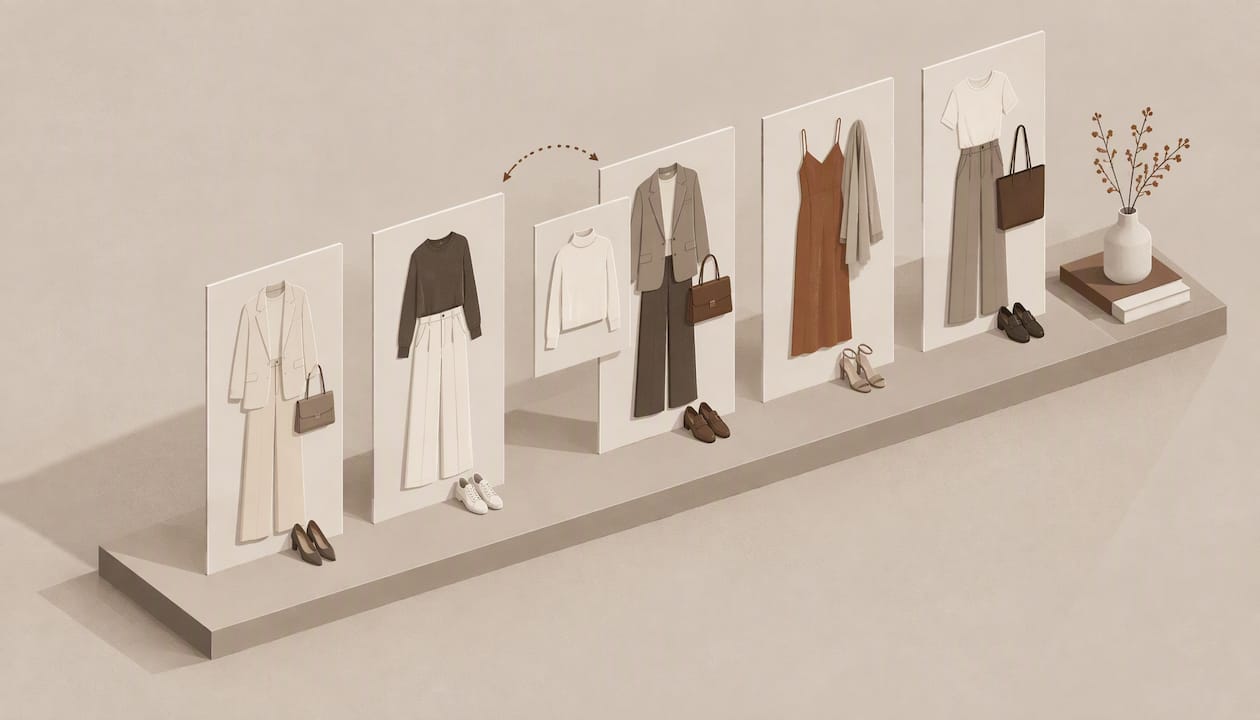
Outfit planning means deciding what you will wear before the morning rush, based on your schedule, the weather and the clothes you already own. The simplest version takes about 30 minutes once a week: check your calendar, pick five looks from your closet, set them where you can grab them, and keep one backup. The rest of this guide shows you how, step by step, and where tools help.
TL;DR
- Plan once a week, ideally Sunday, and build each look around what the day demands: meetings, errands, events, weather.
- Start from a clean, organized closet. You cannot plan with clothes you cannot see or do not like.
- Plan five outfits plus one flexible backup, and store them together in one spot.
- Check the forecast the night before and swap a layer, not the whole outfit.
- A digital closet or app speeds up repeating the process, but the habit matters more than the tool.
Table of Contents
- Why planning outfits works
- Step 1: Start with a closet you can plan from
- Step 2: Map your week before you pick a single piece
- Step 3: Build each outfit from a formula
- Step 4: Check the weather without redoing the plan
- Step 5: Set up a weekly zone
- Step 6: Stay flexible when the week changes
- Common outfit planning problems, and fixes
- Tools that help you plan
- Our perspective: plan from the closet you have
- Make outfit planning easier with Style To Cart
- A 30-minute weekly routine you can copy
- FAQ
- Sources
Why planning outfits works
Most bad mornings are not a style problem. They are a timing problem. You stand in front of a full closet with ten minutes, a vague idea of your day and no clear picture of what goes together. So you reach for the same three things, or you change twice and leave late.
Planning moves the decisions to a calm moment. You are choosing with a cup of coffee, not with a car idling in the driveway. It also shows you something a daily scramble hides: which pieces you reach for, which ones never make it into a plan, and which outfits need one missing item to work.
That last point is where planning turns into better shopping. If you plan a week and the same gap keeps appearing (no neutral shoe that works with trousers, no light layer for cold offices), you now know exactly what to buy and what to skip. For a deeper look at the mechanics of a routine, see our guide to weekly outfit planning.
Step 1: Start with a closet you can plan from
Planning fails fast when the closet is a maze. Before you plan a single outfit, spend one session getting the closet into a state where you can see what you own.
Professional organizers consistently start with the same move: remove what is damaged, stained or no longer fits, because that improves how efficiently the closet works and how visible everything is. Be honest about the pieces you keep “just in case” and never wear. They take up the space your real outfits need.
A few practical principles help the closet support your plan:
- Put everyday items within easy reach. One organizer quoted by Real Simple says the most commonly used items should be the most accessible, even though every closet arrangement is personal.
- Use zones. Organizer Gabai’s approach keeps frequently worn pieces in Zone 1 and out-of-season or rarely used items in Zone 3, such as a bin under the bed. Your planning pool is Zone 1.
- Keep hangers consistent. Matching hangers and properly spaced rods prevent bunching and wrinkles, which means outfits are ready to wear, not ready to iron.
- Make it easy to return things. Another organizer in that piece, Sara Losonci of Shelfie, favors simple, intuitive systems such as basic labeling so clothes go back where they belong.
If your closet needs more than a quick pass, our wardrobe audit walkthrough takes you through it category by category. If storage itself is the bottleneck, these closet organization ideas can help you use the space you have so your clothes stay visible and ready to wear.
Step 2: Map your week before you pick a single piece
The most common planning mistake is starting with clothes. Start with the week.
Open your calendar and write one line per day. You are looking for the factors that change what you can wear:
- Where you will be. Office, home, client site, school pickup, a restaurant, a flight.
- What you will be doing. Sitting at a desk, presenting, walking a lot, carrying a bag, being outdoors.
- Dress expectations. A client meeting needs a different level of polish than a heads-down day. If meetings are a regular puzzle for you, our guide to meeting outfits for women goes step by step.
- Anything after work. A dinner or event means the outfit has to do two jobs, so plan the swap (shoes, jewelry, a jacket) now.
- Weather. Rough is fine at this stage. Highs, lows and rain or no rain.
A week might look like this:
| Day | What’s on | Needs |
|---|---|---|
| Mon | Team meeting, desk work | Polished but comfortable |
| Tue | Client presentation | Most put-together look of the week |
| Wed | Remote, one video call | Camera-friendly top, relaxed bottom |
| Thu | Office, dinner after work | Easy evening swap |
| Fri | Casual office, errands | Comfortable shoes |
This table takes five minutes and does half the planning for you. Tuesday’s look is already decided in spirit before you open the closet.
Step 3: Build each outfit from a formula
Now open the closet. Instead of designing five outfits from scratch, use formulas: a repeatable structure you fill with pieces you own. A few examples:
- Trousers + fitted knit + blazer + loafers
- Midi skirt + tucked tee + cardigan + ankle boots
- Dress + denim jacket or tailored coat + flats
- Straight jeans + crisp shirt + structured bag + sneakers that look intentional
Formulas save time because the structure is already solved and you only choose colors and textures. We have collected a dozen of these in our outfit formulas for your own closet.
Plan with a pairing rule
When choosing, make sure every top you pull has at least two bottoms it works with, and every pair of shoes goes with at least two outfits. This keeps your plan flexible, which matters on the day plans change.
Include one repeat
You do not need five unique looks. Repeating a favorite pair of trousers with a different top and layer is how real people dress, and it makes your week cheaper and calmer. If you want to reduce the pool even further, a capsule wardrobe built from your own closet is the logical next step.
Step 4: Check the weather without redoing the plan
Weather is the variable that breaks most plans, so build the outfit so weather only changes one layer.
On Sunday, glance at the extended forecast just to avoid obvious mismatches, like a linen dress on the coldest day. The evening before, check again using your local forecast from the National Weather Service or your preferred weather app, then adjust.
A layering mindset makes the adjustment easy. For cold days, the NWS advises layers of loose-fitting, lightweight, warm clothing and a hat, and in extreme cold, mittens rather than gloves. In everyday terms, that means every planned outfit should have an obvious option to add or remove:
- A cardigan, blazer or vest over a base layer
- A scarf you can stash in your bag
- A shoe swap if rain is likely (and the dry pair in your bag)
- A coat decision that happens at the door, not in the plan
The rule: the base outfit is fixed, the top layer and footwear are variable. Then a surprise forecast takes 30 seconds, not 15 minutes.
Step 5: Set up a weekly zone
A plan that lives only in your head dissolves by Wednesday. Give the week’s outfits a physical home.
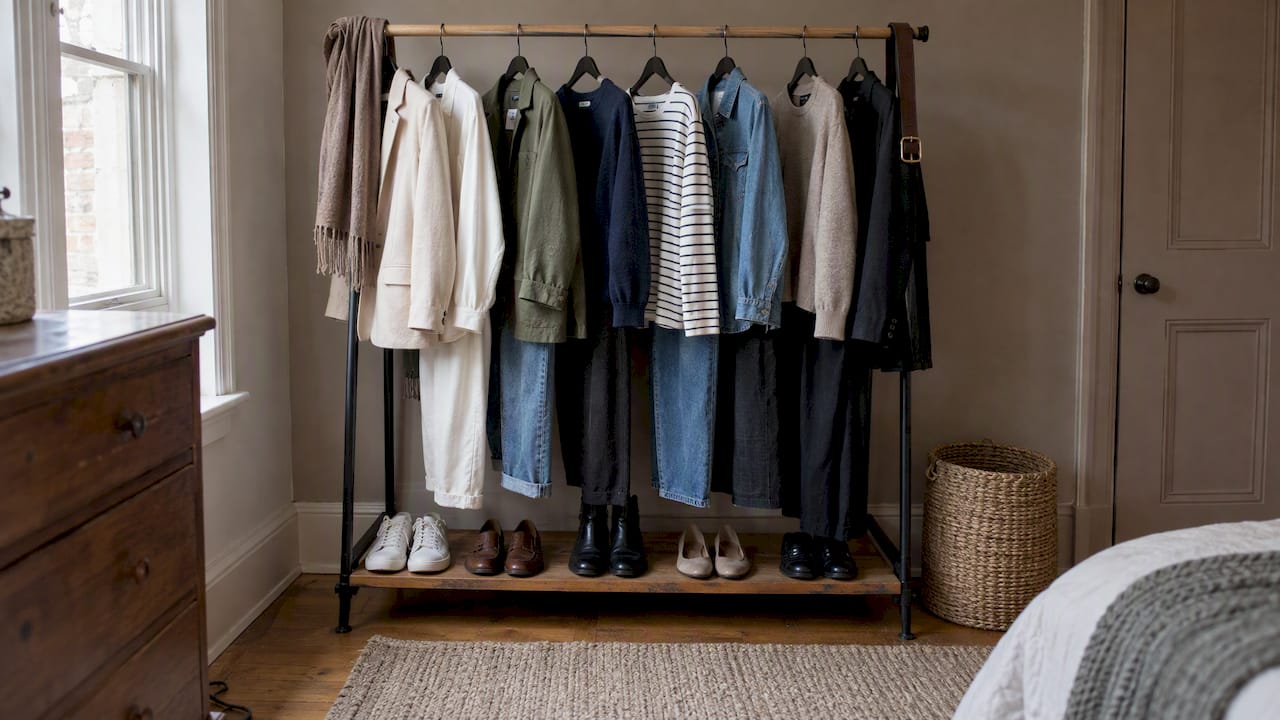
The easiest version is a dedicated section of the closet rod or a small portable rack where the week’s outfits hang in order, Monday on the left. Put shoes on the shelf below, and hang accessories (a scarf, a belt) over the hanger itself. If hanging every outfit is not realistic, a shelf divider for folded knits and denim works just as well.
If you prefer a digital record, take a photo of each laid-out look. A quick snapshot on your phone, saved to an album called “This week,” turns your phone into a lookbook you can check on a rushed morning.
A short end-of-day reset keeps the system alive. Organizer Gabai’s “Back to One” principle, as reported by Real Simple, says a consistent routine such as a 5-minute end-of-day reset returns items to their zones. Real Simple also reports organizers recommending a daily 10 to 15 minute tidy. Pick whichever you will actually do.
The weekly session itself can become a ritual. Our Sunday closet habit shows how to fit it into 20 minutes.
Step 6: Stay flexible when the week changes
Plans change: a meeting moves, a dinner gets added, a cold snap arrives. A good system absorbs this.
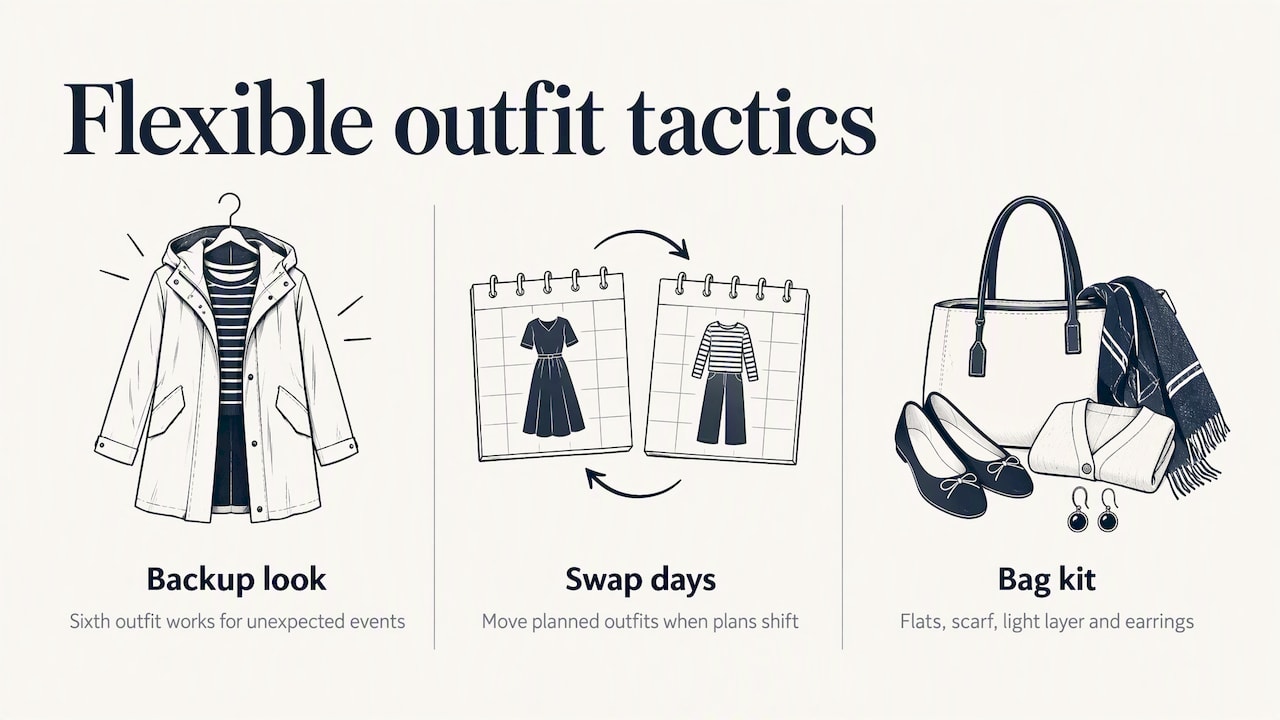
Keep one backup look. Make your sixth outfit a reliable, comfortable, weather-adaptable one you could wear to almost anything. It covers an unexpected event or a day when your first choice does not feel right.
Plan in swaps, not in absolutes. Tuesday’s plan is “blazer look.” If the presentation moves to Thursday, you swap the two days, since both are on the rack.
Keep a “bag kit.” Flats, a scarf, a lightweight layer and a pair of earrings in your bag let one outfit move between settings.
Do a 60-second morning check. Look at the outfit, look out the window and ask whether anything changed. If not, get dressed and go.
Common outfit planning problems, and fixes
| Problem | Why it happens | Fix |
|---|---|---|
| You never wear the plan | Outfits were chosen for an imaginary life | Plan around your real calendar and favorite pieces |
| Planned outfit feels wrong on the day | Mood, comfort or weather shifted | Keep the backup look and one swappable layer |
| You keep wearing the same few things | The rest of the closet does not fit or flatter | Audit the closet and remove or fix what you avoid |
| Everything needs ironing | Planned too late or stored badly | Hang outfits and use the Sunday session to steam |
| Planning takes an hour | You are starting from scratch every week | Use formulas and repeat what worked |
| The closet is full but nothing works | Missing pieces that connect outfits | Track gaps and shop strategically |
That last one is common enough to deserve its own read: why a full closet still feels like nothing to wear.
Tools that help you plan
You can plan outfits with nothing but a calendar and a hanger. Still, tools help in three situations: you have a large closet, you travel often, or you want to track what you wear.
The main types of tools:
- Phone photos and albums. Free, instant, and enough for many people.
- Notes or calendar entries. Add the outfit to the calendar event, such as “Tuesday: charcoal trousers, cream knit, navy blazer.”
- Pinterest-style boards. Good for inspiration, weaker for planning from clothes you actually own.
- Digital closet apps. You photograph or import your clothes, build looks and schedule them. The upside is seeing everything at once. The downside is the upfront time to digitize, and some apps are only organizers and do not tell you what is missing.
- Styling platforms. These go beyond storage by assessing the closet, suggesting new ways to wear what you own and pointing out gaps.
Whatever you choose, judge it by one question: does it make Sunday faster and Tuesday morning easier? If it adds work, drop it.
Our perspective: plan from the closet you have
After more than 20 years as a wardrobe stylist, we have watched the same thing happen in client after client. Women do not lack clothes or taste. They lack a clear view of what they own and a repeatable way to turn it into outfits.
So we do not start with trends or a shopping list. We start with the closet, because the answers are already there: the pieces that work hard, the ones that never leave the hanger and the single item that would connect six outfits. That is the thinking behind our approach to personal style lessons, and it comes from my background in both styling and teaching: explaining fashion in a way that is relatable and practical, so you can repeat it without us.
My advice is to make planning small. Thirty minutes, five outfits, one backup. Do it for three weeks before you judge it. By week three, you will know which outfits you love, and the gaps will be obvious.
— Wendy
Make outfit planning easier with Style To Cart
Style To Cart is the fashion technology platform we built so the closet assessment, gap spotting and outfit planning we do in personal consultations are available to many more women. You can virtually assess your closet, discover new ways to wear pieces you already own, identify what is missing and shop with a plan instead of a guess.
If you want planning that starts from your real clothes, take a look at Style To Cart, or read how Wendy moved from stylist to software founder.

A 30-minute weekly routine you can copy
Here is the whole system in one place. Do it Sunday, or whichever evening suits you.
- Minutes 0 to 5: Check your calendar and the week’s forecast. Fill in the day-by-day table.
- Minutes 5 to 10: Pick the anchor for each day: the one piece that suits the occasion (blazer, dress, trousers).
- Minutes 10 to 20: Build outfits using formulas. Make sure each piece has two possible partners.
- Minutes 20 to 25: Choose accessories and shoes. Add a backup look.
- Minutes 25 to 30: Steam or press anything that needs it, hang the outfits in your weekly zone or photograph them, and note any gap.
The gap note matters most over time. After a month, you will have a short, honest list of what would improve your outfits, and you can shop from it instead of from impulse.
FAQ
How do I plan outfits for the week?
Start with your calendar and note where you will be, what you will do and what the weather looks like each day. Then build one outfit per day from formulas you like, add a backup look and store them together in one place. The whole process takes about 30 minutes once your closet is organized.
What should a weekly outfit planner include?
A good planner has the day, the occasion or dress expectations, the weather, the outfit itself and the shoes and accessories. A space for notes on what is missing is useful too. It can be a paper page, a note on your phone or a digital closet tool.
How far ahead should I plan outfits?
A week is the sweet spot for most people, because it matches your calendar and still lets you adjust. Check the forecast the night before and swap only the top layer or shoes if needed. Planning a whole month tends to fall apart when schedules shift.
Is there an app where I can plan my outfits?
Yes, many digital closet apps let you photograph your clothes, build outfits and schedule them on a calendar. Whether you need one depends on how big your closet is and how much you travel. If you only want a record of what you planned, a photo album on your phone does the job for free.
Sources
- The Right Way to Arrange Clothes in Your Closet, Real Simple
- I Hired a Pro at Closet Clean-Outs, Who What Wear
- 8 Closet Organization Mistakes That Annoy Pro Organizers, Real Simple
- 7 Tips to Prevent “Floordrobe” and Keep Clothes Tidy, Real Simple
- Extreme Cold Safety Tips, National Weather Service
Recommended
About Wendy
Wendy Pilch is an award-winning wardrobe stylist, entrepreneur and Founder & CEO of Style To Cart. After more than 20 years of helping women build wardrobes and define their personal style, Wendy is bringing that experience to fashion technology.