Wardrobe Audit: A Stylist’s Step-by-Step Guide

A wardrobe audit is a stock check of everything you own: what you wear, what doesn’t fit, what’s worn out, and what you keep buying that never gets worn. Done well, it ends with three things: a smaller set of clothes you trust, a handful of outfits you can repeat, and a short, specific list of what’s missing. Done badly, it ends with an exhausted Sunday and a bag of clothes you’ll regret.
We’ve spent over 20 years styling women’s wardrobes, and the audit is where almost every session starts. Below is the method we use, adapted so you can run it yourself, in stages, without losing a weekend.
TL;DR
- Audit in small categories (blazers, then jeans, then shoes), not the whole closet at once.
- Sort every piece into keep, alter, repair, sell or donate, and be honest about fit, condition and how your life looks right now.
- Don’t stop at decluttering: turn what you keep into outfits, then write a short gap list before you shop.
- Your climate, job and laundry habits decide how many pieces you need. Capsule formulas are guides, not rules.
- Keep the audit alive. A digital closet makes the next review take minutes instead of hours.
Table of Contents
- What a wardrobe audit is (and what it isn’t)
- Before you start: set up for a two-session job
- How to do a wardrobe audit, step by step
- A wardrobe audit checklist you can print
- How many pieces should you keep?
- The audit for a work wardrobe
- Why your closet can be full and still feel empty
- Fill gaps without replacing everything
- Look beyond fit: fibers and quality
- Keep the audit alive with a digital closet
- Our perspective: the audit should end in outfits
- Let Style To Cart run the next audit with you
- FAQ
- Sources
What a wardrobe audit is (and what it isn’t)
British Vogue describes an audit as a stock check of what you own: you sort into smaller categories, spot the neglected pieces and one-time purchases, repair or rehome what no longer serves you, and use what you learn to buy more deliberately.
That last part is the one people skip. A purge feels productive, but if you finish with a emptier closet and no plan, you’ll refill it the same way you filled it the first time. In our experience, the audit only works when it ends in outfit use and a prioritized gap list, not just fewer hangers.
It also isn’t a verdict on your taste or your body. Clothes that don’t fit today aren’t a failure. They’re information.
Before you start: set up for a two-session job
Most audits stall in the first twenty minutes because the setup was wrong. Get these in place first.
- Pick a purpose. “Clean out my closet” is vague. “Make weekday work outfits easy” or “figure out why I own 14 black tops and still feel underdressed” gives you a filter for every decision.
- Block the time in two or three sittings. Ninety minutes with a clear category beats a whole Saturday of fatigue. Decision quality drops fast when you’re tired, and the last hour of a marathon session is when people toss good pieces.
- Clear a landing zone. A bed or a clean floor, plus a mirror, good light and a chair. You need room to lay things out.
- Set up five containers. Keep, Alter, Repair, Sell, Donate. Add a sixth for sentimental pieces you aren’t ready to decide on, with a lid and a date to revisit it.
- Have your calendar in mind. Think about a normal week: how many days in an office, how many on video calls, how many at home, how many evenings out. The audit is for that life, not the one in your head.
How to do a wardrobe audit, step by step
Step 1: Start with one category
Vogue’s advice is to work through manageable subcategories, such as blazers within jackets or jeans within bottoms. We agree, and we’d add a rule: start with the category that causes you the most friction on a normal morning. For many of the busy professionals we work with, that’s workwear. If you start with the easy stuff like scarves, you’ll build momentum but leave the real problem untouched.
Step 2: Take everything out and look at it together
Pull every item in the category out, all of it, and lay it in one place. Seeing nine pairs of black pants side by side tells you more than any list. Note duplicates, near-duplicates and the pieces you forgot you owned.
Step 3: Try on, don’t guess
If an item is in doubt, put it on. Check these things, in this order:
- Fit now. Does it fit the body you have today, without a someday caveat?
- Comfort. Can you sit, reach and walk in it for a full day?
- Condition. Pilling, stretched seams, faded color, stains that didn’t come out.
- Message. Does it look like the person you want to be seen as at work, at dinner, on the weekend? The Image Institute’s wardrobe workbook frames this well: it asks you to remove or set aside items that no longer fit, are worn out, feel uncomfortable, look dated, or don’t support the image and work demands you want to project, and notes that suitable pieces may be altered while gently used ones can be sold or donated.
- Pairing. Name at least three things it goes with. If you can’t, it’s an orphan.
Step 4: Sort into your containers
Use a simple decision table so you don’t relitigate every piece.
| What you find | Where it goes |
|---|---|
| Loved, fits, in good shape, worn in the last year | Keep |
| Great piece, small fit problem (hem, waist, sleeve length) | Alter |
| Good piece with a missing button, loose hem, worn heel tips | Repair |
| Good condition, you’re simply not wearing it | Sell or donate |
| Tags still on, never worn | Ask why (see below), then keep or return |
| Worn out, stained, beyond repair | Textile recycling or rags |
| Tied to a memory | Sentimental box, revisit in 3 months |
The “tags still on” row deserves attention. A never-worn piece is the most valuable data point in the audit. It tells you what you bought for an imaginary life: the dressy jumpsuit with no occasion, the trend piece that doesn’t suit your shape. Write those down. They are the patterns to break.
Step 5: Put the keepers back in a way you can see them
Group by category, then by color within the category. Put the pieces you wear weekly at eye level. Move seasonal pieces out of the way. The goal is that on a Tuesday at 7:15 a.m., you can see what you own without digging.

Step 6: Build outfits before you shop
This is the step that separates an audit from a clear-out. Take your keepers and assemble complete outfits: top, bottom, layer, shoes, accessory. Photograph each one. A fast way to start is to borrow structures that already work, like the ones in our 12 outfit formulas you can copy from your closet.
As you build, you’ll find two things: pieces that unlock lots of outfits (your workhorses), and pieces that connect to nothing. The second group is your gap list in disguise.
Step 7: Write the gap list
A gap is not “I need more clothes.” It’s a specific hole: “a mid-heel shoe that works with both trousers and dresses,” or “a lightweight layer for over-air-conditioned offices.” Keep it to five items or fewer, ranked by how many outfits each would unlock. If you want a format for this, our guide on building a clothing wish list that actually works walks through it.
A wardrobe audit checklist you can print
Run each piece through these questions. Two or more “no” answers usually means it’s time to alter, repair or let go.
- Does it fit me today, comfortably, sitting and standing?
- Have I worn it in the past 12 months (or, for formal and seasonal pieces, in the last two relevant seasons)?
- Is it in good condition, or fixable for a reasonable cost?
- Do I like how I feel in it, not just how it looks on a hanger?
- Can I name three outfits I’d wear it in?
- Does it suit my current work setting, climate and social life?
- Would I buy it again today at this price?
- If it’s a duplicate, is this the best version of it?
And for the closet as a whole:
- Do I have outfits for each type of day I actually have (office, remote, travel, events, errands)?
- Are the foundations covered: shoes, outerwear, a few well-fitting bottoms?
- Is there a color or silhouette I over-rely on?
- What did I buy last year that I never wore, and why?
How many pieces should you keep?
There’s no magic number. The New York Times reported in 2025 that formulas like 3-3-3 and 5-4-3-2-1 are competing ways to maximize combinations, and that people disagree on which is best. They were discussing travel packing, but the lesson applies at home: a formula is a starting heuristic, not a target.
Your count depends on:
- Climate. Four real seasons need more outerwear and layering than a mild coastal city.
- Work setting. A client-facing job needs more polished pieces than a hybrid schedule.
- Laundry rhythm. If you do laundry every two weeks, you need more rotation than if you wash weekly.
- Travel and events. A few dressier or packable pieces matter if you’re on the road often.
If you like the capsule idea, it simply means a small group of essential, fairly timeless pieces supplemented by seasonal items. The term has been traced to a London boutique owner in the 1970s and Donna Karan’s 1985 “Seven Easy Pieces”. It was always about mixing and matching, not about hitting a count.
The audit for a work wardrobe
A professional wardrobe has a different job from a weekend one: it has to work fast, and it has to work in more than one setting. The Image Institute workbook organizes this by category (jackets, bottoms, tops, shoes, accessories) across business, business-casual, casual and evening. We find that grid useful because it shows imbalances quickly. Many women discover they have plenty of business-casual tops and almost no jackets that finish them.
When you audit workwear, add three tests:
- The camera test. Does it look right on a video call, from the chest up?
- The 10-minute test. Can you get dressed in ten minutes, with no ironing, no pinning, no second guessing?
- The range test. Can this piece go from a meeting to dinner with one change? Our day-to-night styling formula shows how.
If mornings are your pain point, pair the audit with a routine. Our five-minute work wardrobe method and weekly outfit planning system are built for exactly that.
Why your closet can be full and still feel empty
If the audit shows you own plenty but still reach for the same five things, you’re not alone, and the problem is usually pairing, not quantity. Pieces bought one at a time, to fill an immediate need, rarely work together. We unpack this in why your closet feels full but you have nothing to wear.
The common patterns we see:
- Quantity problem: too many pieces, so nothing is visible.
- Matching problem: lots of tops, no bottoms that suit them.
- Condition problem: things that technically fit but look tired.
- Storage problem: good clothes buried or crammed.
- Shopping problem: you buy the same thing again, or buy for a life you don’t lead.
Name which one is yours. The fix is different for each.
Fill gaps without replacing everything
A good audit makes shopping smaller, not bigger. Most gaps are filled by one or two well-chosen pieces that connect what you already own.
The New York Times’ style advice on refreshing a wardrobe makes a helpful point: shaking yourself out of a comfort zone can be as simple as a controlled shift in color or silhouette, rather than a full overhaul. Try changing one variable at a time: a new neutral, a different pant shape, a color you’ve avoided. Our 10 outfit color combinations you can actually wear is a good place to start.
Small finishing touches count too. Scent, for instance, is one of the cheapest ways to change how an outfit feels without buying another garment, and sampling before committing to a full bottle follows the same logic as trying before buying clothes. This overview of fragrance trends and sampling before buying a bottle is a useful starting point.
If you’re a millennial rethinking pieces bought a decade ago, our millennial wardrobe reset covers what’s worth owning now.
Look beyond fit: fibers and quality
If sustainability matters to you, widen the audit to include materials. Fibershed’s clothing guide suggests choosing quality over quantity and keeping clothes in use as long as you can, and notes that labels often don’t give a full account of materials, makers or impacts. In practice, that means checking the fiber content on the pieces you wear most, noting which ones hold up after washing, and letting that shape what you buy next. The goal isn’t perfection. It’s a better record of what lasts for you.
Keep the audit alive with a digital closet
A paper audit is a snapshot. Within a season it’s out of date. That’s why many people now photograph and catalog their clothes.
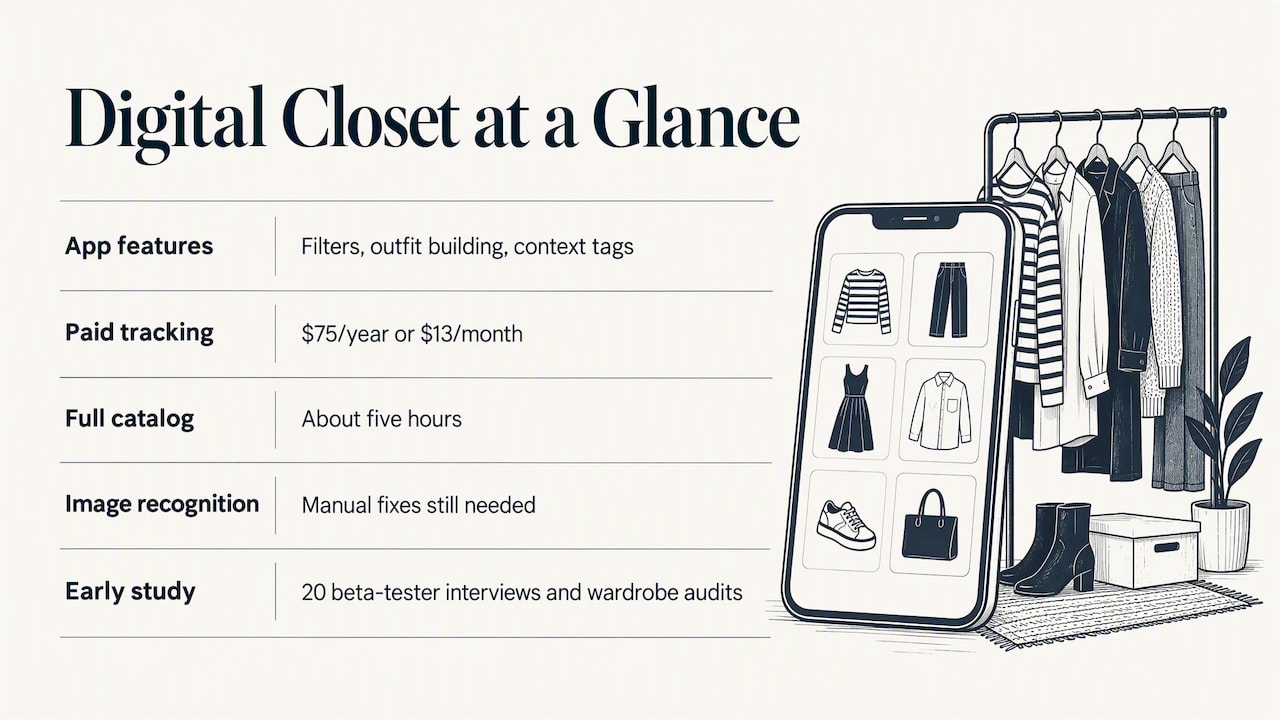
Wirecutter’s 2026 review of one digital wardrobe app found that a digital closet can filter by category, season and color, let you build outfits by dragging pieces together, and tag looks for contexts like rain or working from home. In that app, paid features, such as cost-per-wear tracking, were reported at $75 per year or $13 per month. That’s one reviewed app, not a market-wide price.
The same review is honest about the downside: cataloging a full wardrobe took about five hours, and image recognition still needed manual fixes. That’s why we suggest the staged approach above. Photograph your workwear first, start using it, and add the rest over a few weeks.
Research points the same way, with caution. A preliminary University of Glasgow study used 20 in-depth interviews and wardrobe audits with beta testers to look at how digital wardrobe tools might help people make better use of the garments they already own. It’s early, qualitative work, so it supports the idea that visibility helps decisions, not that any tool guarantees you’ll buy less.
Our perspective: the audit should end in outfits
After two decades of working in people’s closets, here’s what we believe about audits.
The purge is the least important part. Women almost always know what to get rid of. What they don’t know is what to do with what’s left, and that’s where the frustration comes from. A closet of 40 well-chosen pieces can still feel like nothing to wear if no one has shown you how they combine.
Because of my background in education as well as styling, I teach the audit as a skill rather than a one-time fix. When you understand why a piece works, such as its proportions, its color relationships and what it anchors, you make better decisions in the store, too. Personalized consultations taught us that every woman’s audit looks different, because her climate, work, body and routines are different. That’s why we built Style To Cart: to take what we do in person and make it available to more women, so you can assess your closet virtually, see your gaps and find new ways to wear what you already own.
Our advice is simple. Audit in stages. Keep what fits your real life. Build outfits before you shop. Then shop with a list.
— Wendy
Let Style To Cart run the next audit with you
If you’d rather not do this with a pile of hangers and a notes app, Style To Cart is our fashion technology platform for women. It lets you assess your closet virtually, identify gaps, organize your wardrobe, plan outfits and get strategic shopping recommendations, all informed by our hands-on styling experience. You can start at wendypilch.com or read about how a stylist became a software founder.
FAQ
How often should I do a wardrobe audit?
Most people benefit from a full review once or twice a year, usually at a season change, with a quick check of one category whenever something feels off. There’s no research-backed universal interval, so choose a rhythm you’ll actually keep. A digital closet makes the in-between check-ins much faster.
What’s the difference between a closet audit and a wardrobe review?
In everyday use, they mean the same thing: a structured look at what you own. We’d draw one distinction. A review can be a quick look, while an audit follows a method and ends with decisions and a gap list.
How do I know what to get rid of?
Start with what doesn’t fit now, what’s worn out, what’s uncomfortable, and what you can’t pair with at least three other pieces. Pieces that need small changes go to a tailor or repair, and good-condition items can be sold or donated. If you hesitate, use the sentimental box and revisit it in three months.
Should I audit my whole closet at once?
Usually not. Working in subcategories such as blazers or jeans keeps decisions sharp and the job manageable. Start with the category that causes you the most trouble on a regular weekday.
Sources
- Why A Wardrobe Audit Can Help You Be More Sustainable In 2023, British Vogue
- Wardrobe Workbook, Image Institute
- What’s the Perfect Capsule Wardrobe for Traveling?, The New York Times
- Life is easier with a capsule wardrobe, The Washington Post
- How Do I Upgrade My Carhartt Wardrobe?, The New York Times
- Clothing Guide, Fibershed
- I Catalogued My Wardrobe ‘Clueless’-Style, Wirecutter
- Save Your Wardrobe: Digitalising Sustainable Clothing Consumption, University of Glasgow
Recommended
About Wendy
Wendy Pilch is an award-winning wardrobe stylist, entrepreneur and Founder & CEO of Style To Cart. After more than 20 years of helping women build wardrobes and define their personal style, Wendy is bringing that experience to fashion technology.