How to Build a Clothing Wish List That Actually Works

A good clothing wish list is not a collection of things you like. It is a short, specific list of pieces your current wardrobe is missing, each one checked against what you already own, and each one made to wait before you buy it. Done this way, the list stops impulse purchases, shows you the gaps in your closet, and tells you what to buy first when a sale comes around.
Most wish lists fail for one reason: they turn into a mood board. Forty saved dresses, no budget, no notes, no link to your real life. Below is how to build one that earns its place, with a simple format, a waiting rule, and a way to test every item before it becomes a purchase.
TL;DR
- A wish list works when every entry answers a gap in your wardrobe, not a passing craving.
- Write down the occasion, the pieces it would pair with, and a price ceiling for each item.
- Let items sit for 30 days before buying. Many shoppers find the urge fades or an outfit they already own does the job.
- Review the list weekly in a couple of minutes and cut anything that no longer earns its spot.
- Check each item against your closet first: if you cannot style it three ways with what you own, it is not ready to buy.
Table of Contents
- What a clothing wish list is really for
- Start with your closet, not with the store
- What belongs on the list
- The 30-day rule
- Keep it small enough to use
- Where to keep your list
- Perspective: why we think most wish lists fail
- Turn the list into a plan: a worked example
- Common mistakes to avoid
- Where Style To Cart fits
- FAQ
- Sources
What a clothing wish list is really for
Think of the list as a brake pedal, not a shopping cart. One stylist describes the wardrobe wish list as an “icing on the cake” tool that slows the buying process down. Because an item has to sit on the list before you purchase it, you get time to compare prices, think it over, and judge fit. That pause is what prevents the regret that follows a social-media-fueled splurge.
That framing matters because it changes what you put on the list. A list built as a brake has few items and a lot of detail. A list built as a dream board has many items and no detail. Only the first one helps you shop.
It also helps to separate three things people lump together:
- A wish list holds items you want but are not buying yet.
- A shopping list holds items you have decided to buy, usually for a specific trip or sale.
- A gap list holds the categories your closet is missing, such as a work-ready blazer or a comfortable pair of flats, before you pick any particular product.
The strongest system uses all three in order. You start with gaps, turn them into wish list items, and only then promote an item to the shopping list.
Start with your closet, not with the store
The most common mistake is starting a wish list from inspiration. You scroll, you save, you collect. The list ends up reflecting what stores and influencers are showing, not what you need.
Start in the other direction. Before you add a single item, spend an hour with your closet and answer four questions:
- What do you actually wear? Pull out the ten pieces you reach for most often. They tell you your real style, which is often different from your aspirational one.
- What do you never wear, and why? Fit, color, comfort, or no matching pieces? The reason matters, because it keeps you from repeating the mistake.
- Where do outfits fall apart? Maybe you have plenty of tops but only one pair of pants that works for the office. Maybe your shoes do not suit half your dresses.
- What does your week demand? A busy professional with three days of in-person meetings, a gym habit and a weekend of errands needs a different wardrobe from someone working from home.
The answers become your gap list. Every wish list entry should trace back to one of those gaps. If it does not, it is a want, and wants can wait on a secondary section of the list or be dropped.
What belongs on the list
A useful entry has more than a product name. Here is the format we recommend, and it takes about a minute per item:
| Field | What to write | Why it matters |
|---|---|---|
| Item | Specific description: “dark straight-leg jeans, 30-inch inseam” | Keeps you from buying the near-miss version |
| Gap it fills | “No casual pants that work with my blazers” | Proves the need |
| Pairs with | Three pieces you already own | Confirms it earns its place |
| Occasion | Work, weekend, travel, events | Shows how often you would wear it |
| Price ceiling | The most you will pay | Protects your budget |
| Date added | Today’s date | Starts the waiting clock |
| Fabric and fit notes | Fiber content, cut, what to avoid | Saves time when you shop |
The “pairs with” column is the one that does the most work. If you cannot name three things you own that the new piece works with, you are buying an outfit-in-waiting, not a wardrobe piece. That is how closets fill up with items that hang untouched.
Write down the wears you expect
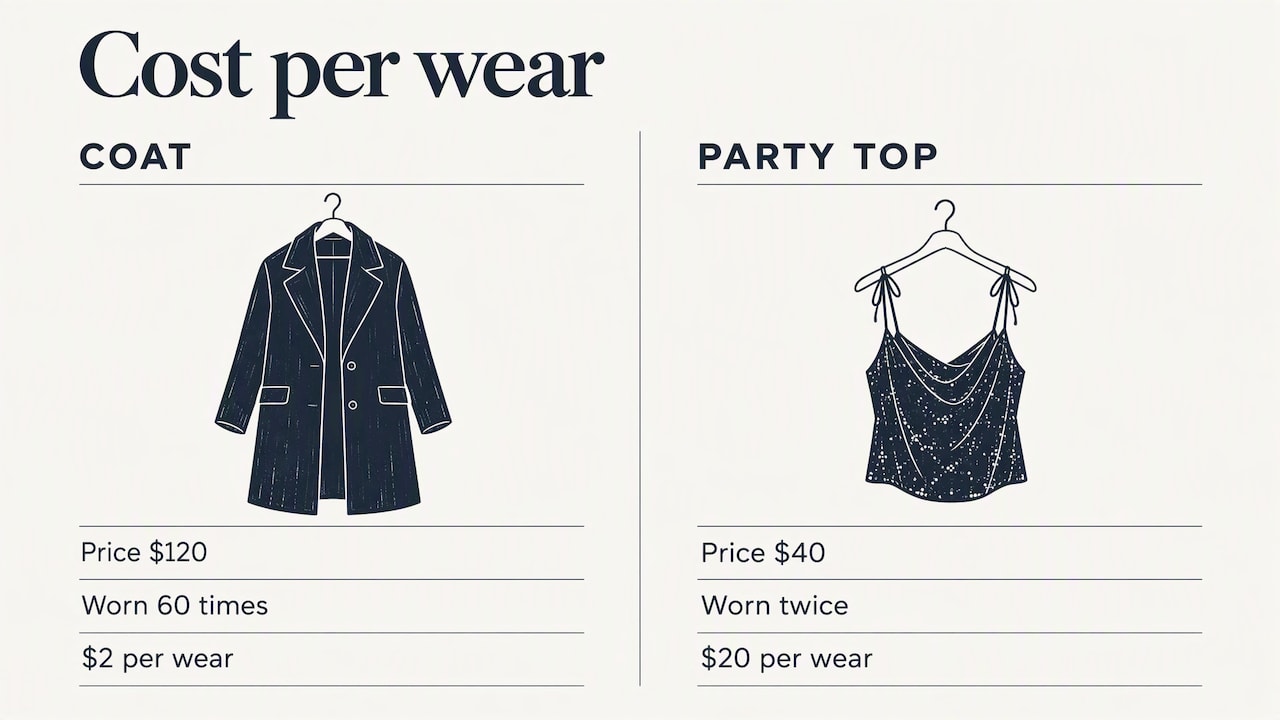
Add a rough guess of how often you would wear the piece in a year. Divide the price by that number and you have a cost per wear. A $120 coat you would wear 60 times costs $2 per wear. A $40 party top you would wear twice costs $20 per wear. The math is simple, but seeing it next to the item changes the decision.
Use the basics as a reference point, not a rulebook
If your closet is thin, a capsule framework is a reasonable starting point for ideas. Styling experts cited by Women’s Health describe capsule wardrobe essentials as timeless, quality pieces that mix and match across seasons, such as a white cotton button-down, straight-leg denim, neutral knit sweaters, a versatile trench coat and tailored trousers. The same article suggests natural fibers like cotton, silk, wool or linen for durability and breathability, with a little elastane to help a garment hold its shape.
Use that as a prompt, not a mandate. If you never wear trench coats, a trench coat does not belong on your list just because a guide says so. The framework is useful only where it matches your life.
The 30-day rule
This is the habit that gives a wish list its power. When you see something you want, add it to the list instead of buying it. Then leave it alone for 30 days.
One shopper who tracks her wardrobe in an app describes exactly this routine: add the item to a wishlist, photograph similar pieces already owned, and revisit after a month. She reports that about 80% of the time she no longer wants the item or realizes she can create a similar look with what she has. That is one person’s experience, not a controlled study, but it matches what many stylists see: desire fades faster than the credit card statement.
Here is how to make the rule easy to follow:
- Date every entry. The date is the whole mechanism. No date, no rule.
- Photograph what you already own that is similar. Seeing three near-identical black cardigans in a row is a quiet, effective argument against a fourth.
- Allow a fast lane for true needs. If your only pair of work shoes just fell apart, you do not need a month. The rule is for wants, and you are the judge of which is which, so be honest.
- Check price and stock after 30 days. Some items go on sale. Some sell out. Either outcome is information, and neither should trigger panic.
What to do when the item is still there and you still want it
Good. Now run the final test: try the “pairs with” outfits on paper or in your head. If you can build at least three outfits, move the item to your shopping list, check the return policy, and buy it at or below your price ceiling.
Keep it small enough to use
A list with 80 entries is not a plan. It is a browser history. We suggest capping the active list at 10 to 15 items. If you want to hold more ideas, keep a separate “someday” section that you do not shop from.
Prioritize with three labels:
- Fills a gap now. Shop for these first.
- Upgrades something I own. Worth buying when the old piece is worn out or a better version is on sale.
- Nice to have. Review these only at the monthly check-in, and cut freely.
The weekly review matters more than the format you choose. A recent roundup of closet-tracking habits claims that a 2-minute weekly review of a wardrobe tracker cuts impulse purchases, and that a structured digital wishlist and inventory system can lower annual fashion spending considerably. Those figures come from a single article and rely on self-reported results, so treat the exact percentages as encouraging rather than guaranteed. The direction, though, is sensible: a list you look at every week shapes your habits, and a list you forget does nothing.
Where to keep your list
You have several reasonable options, and the best one is the one you will open every week.
A notes app or spreadsheet. Free, flexible, and fine if you are disciplined. The columns in the table above translate directly. The downside is that your list lives apart from your closet, so the “pairs with” step takes manual effort.
A shopping-site wish list. Convenient, but it is built to sell. Stores send reminders and price-drop alerts designed to bring you back to buy, which defeats the purpose of a cooling-off period. If you use one, turn the notifications off.
A paper notebook. Underrated. Writing an item by hand adds friction, and friction is the point. It works well for people who prefer to plan outfits visually with sketches or clipped photos.
A digital wardrobe tool. This is the strongest option because the list and the closet sit in the same place. You see what you own while you decide what to add, which is the whole job of a wish list. Several kinds of apps do this, from simple closet catalogs to ones that generate outfits.
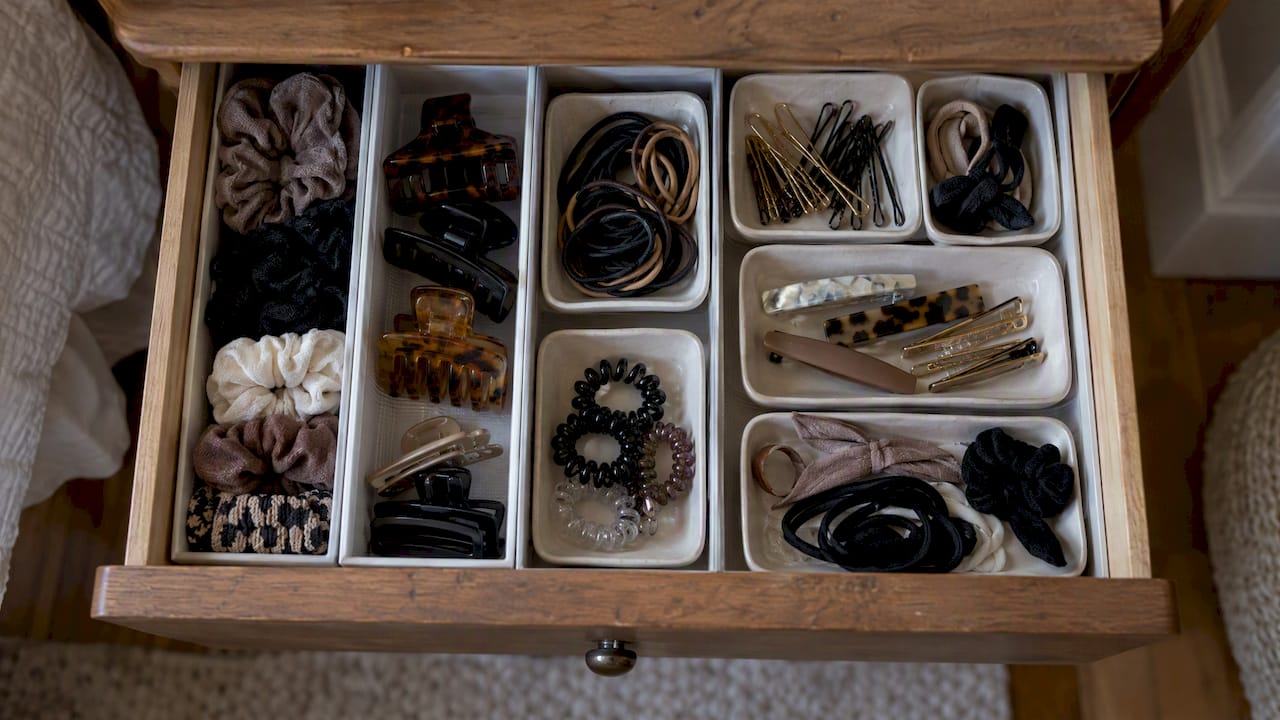
Whichever you pick, give small accessories the same attention as clothes. Belts, scarves, hair clips and jewelry are where duplicates pile up unnoticed. Physical organization helps here too: before buying another set, it is worth looking at how others sort small items, such as this guide to organizing a hair accessories drawer with dividers and trays, so you can see what you already have.
Perspective: why we think most wish lists fail
After more than 20 years of styling women’s wardrobes, one pattern stands out. The women who struggle most with shopping rarely have a taste problem. They have an information problem. They do not know exactly what is in their closet, so they cannot tell what is missing, and every shopping trip becomes a guess.
A wish list built on a guess inherits the guess. It fills up with items that look good alone but have nothing to pair with at home. We have seen closets where the owner had twelve tops she loved and one pair of pants that fit, and the wish list was still full of tops.
That is why we start with the closet, not the store. When a client can see her whole wardrobe in front of her, the gaps become obvious, and the wish list writes itself. It gets shorter, more specific and much cheaper. It also becomes easier to say no, because “I already have that look” is a stronger reason than willpower.
We also coach women to treat the list as a teaching tool. Each entry forces a question: what would this go with, when would I wear it, and what does that say about how I dress? Answer those honestly for a few months and your instincts improve. You begin to spot the right piece faster and the wrong one sooner. Our background in education shapes how we teach this, so that it feels relatable rather than rule-bound.
That approach is what we built into Style To Cart: take what works in a personal consultation and make it available without needing an appointment.
— Wendy
Turn the list into a plan: a worked example
Say you work in an office three days a week and your closet feels full but frustrating. You spend an hour on a Sunday and find these gaps:
- No comfortable shoes that look polished for commuting.
- Only one pair of pants works with your three blazers.
- Most of your tops are patterned, so they do not layer well.
- A coat that suits both office and weekend is missing.
Your wish list now has four real entries instead of forty vague ones:
- Neutral leather flats, price ceiling $90, pair with the navy trousers, gray dress and green midi skirt you already own.
- Tailored black trousers, price ceiling $110, pair with all three blazers and two silk tops.
- Two solid knit layers in cream and charcoal, price ceiling $60 each, pair with the patterned skirts.
- A mid-weight coat in a neutral shade, price ceiling $220, pair with everything above.
Each item is dated. You review the list every Sunday. After 30 days, the knits are still there and still make sense, so you buy them when a store you trust has a sale. The coat gets moved to “upgrade when needed,” because your current one still works. The flats come off the list entirely after you realize an old pair only needed a repair.
That is the process working: fewer purchases, each one deliberate, and money saved on things you did not actually need.
Common mistakes to avoid
- Saving trends instead of needs. A trend belongs on the list only if it fits your life and your closet.
- Ignoring fabric and care. Note fiber content and care instructions. A piece that needs dry cleaning every wear is a hidden cost.
- Skipping the return policy. For online buying, check it before you pay, not after the item arrives.
- Never pruning. Delete items every month. A list is a living document.
- Forgetting the budget. A price ceiling per item, and a monthly total, keeps the list honest.
- Shopping from the list when you are tired, stressed or bored. Those are the moments the waiting rule exists for.
Where Style To Cart fits
If you want your wish list and your closet in one place, that is what Style To Cart is designed for. The platform lets you virtually assess your closet, spot the gaps, find new ways to wear what you already own, and get strategic shopping guidance based on what is really missing. It turns the consultation process Wendy has used with clients for over 20 years into software you can use on your own schedule. You can start at the Style To Cart home page, or read how Wendy went from stylist to software founder. For more styling ideas, browse The Edit.
FAQ
How do I make a clothing wish list?
Start with your closet and identify the gaps, such as missing basics or pieces that do not pair with anything. Then add each item with the gap it fills, three things it would pair with, a price ceiling and today’s date. Keep the active list to 10 to 15 items so you actually use it.
What is the difference between a wish list and a shopping list?
A wish list holds items you want but have not committed to buying, and it is meant to be reviewed and pruned. A shopping list holds items you have decided to purchase, usually after they passed your waiting period and your pairing test. Moving an item from the first to the second should take effort.
How long should I wait before buying something from my list?
Thirty days is a practical default. One shopper reports that roughly 80% of items lose their appeal after a month or turn out to be replaceable with something she owns. Shorten the wait only for genuine replacements, such as a worn-out pair of work shoes.
What clothing basics should I put on my wish list first?
Only the ones missing from your own closet. Common capsule staples include a white cotton button-down, straight-leg denim, neutral knits, a versatile coat and tailored trousers, as listed by Women’s Health. If you already own a good version of any of them, leave it off.
Should I use an app or a notebook?
Use whichever you will open weekly. A notebook or spreadsheet is fine if you are disciplined. A digital wardrobe tool is stronger because you can see what you own while deciding what to add, which makes the gap check faster.
Sources
About Wendy
Wendy Pilch is an award-winning wardrobe stylist, entrepreneur and Founder & CEO of Style To Cart. After more than 20 years of helping women build wardrobes and define their personal style, Wendy is bringing that experience to fashion technology.