Personal Stylist Cost in 2026: What You’ll Really Pay

Most independent personal stylists in the US charge somewhere between about $100 and $300 an hour. A closet edit or a shopping day often runs from a few hundred dollars to well over $1,000. Ongoing retainers cost far more. The number on the rate card matters less than what the hours include, so this guide breaks down each type of service, the extras that change the bill, and the cheaper routes that can get you most of the way there.
TL;DR
- Independent stylists commonly quote roughly $100 to $300 per hour. Big-city rates sit at the top of that range, and smaller markets often come in lower.
- Packages of four to eight hours typically land in the hundreds of dollars. Full reinventions and retainers can reach the thousands.
- Retailer styling can be free or cheap, but it is built around that store’s inventory, not your whole wardrobe.
- Ask what the hours include: prep, travel, written outfit plans, returns, alterations and follow-up all change the effective price.
- If your real problem is deciding what to wear from what you already own, software can cover that part for a fraction of a stylist’s fee.
Table of Contents
- What a personal stylist costs in the US
- The types of styling help, and what each costs
- What changes the final price
- Worked examples: three budgets
- Is a personal stylist worth it?
- How to spend less without losing the benefit
- Our perspective: where a stylist’s money goes
- Where Style To Cart fits
- A quick checklist before you book anyone
- FAQ
- Sources
What a personal stylist costs in the US
Published price guides disagree on the exact figures, which is normal. Stylists set their own rates, and the market has no standard. Here is the shape of it as of this year.
| Type of service | Typical range you will see quoted | What you usually get |
|---|---|---|
| Hourly consultation | About $75 to $300+ per hour | Advice on a defined task, such as a work wardrobe question |
| Four-hour package | Roughly $300 to $600 | Closet audit, outfit planning, a shopping game plan |
| Eight-hour package | Roughly $600 to $1,200 | A closet edit plus a shopping session, sometimes over two days |
| Closet edit and shopping bundle | A few hundred to $1,500 or more | Sorting, outfit building, a guided shopping trip |
| Ongoing styling membership | Several thousand dollars a year, and up from there | Seasonal updates, event styling, text-message support |
Treat these as ranges, not quotes. Rates depend on the city, the stylist’s reputation and the number of hours you buy. A stylist in Manhattan or Los Angeles will usually charge more than one in a mid-sized Midwestern city, and a stylist with a celebrity client list will charge more than a newer one building a client base.
Packages can lower the effective hourly rate, but only if the included work matches what you need. A discounted ten-hour bundle is no bargain if six of those hours go to a shopping trip you did not want.
What does a four-hour session cost?
For a four-hour engagement, a realistic benchmark is a few hundred dollars. One commonly published figure is about $320 for a package covering a closet audit, outfit planning and a shopping plan, with an eight-hour package at about double that. Premium stylists and big-city specialists can charge substantially more for the same four hours.
A four-hour booking is also not always four hours of visible shopping. Some of that time is preparation: the stylist reviewing your photos, pulling pieces ahead of time, or building the plan. A three-hour closet consultation, for example, may be spent sorting clothes into keep, alter and donate piles, then building new looks from what you already have. That is real work, but it feels different from a day in the stores.
The types of styling help, and what each costs
Closet edit and outfit building
This is the most defensible spend for most women. A stylist comes to your home or works through photos, sorts your wardrobe, tells you what to keep, tailor or let go, and builds outfits from the pieces that remain. Because it works from clothes you already own, it can reduce unnecessary purchases rather than add to them. Expect to pay for several hours, and expect the stylist to be clear about whether follow-up documents, such as photographed outfit lists, are included.
Personal shopping
Here you pay for a stylist’s time in stores or online, usually with a plan in advance. Some stylists charge an hourly fee, some take a commission from retailers, and some do both. Ask which, because a commission arrangement can quietly shape what gets recommended.
Retailer styling
Department stores offer the cheapest entry point. According to trade coverage of in-home retail styling, the range runs from a low-touch option, where someone helps you find a size in the store, to a high-touch home visit. At the time of that reporting, the premium tier was a service where a stylist comes to you. Some large retailers also offer free in-store and online styling appointments, and some paid home or office visits charge a fee, often in the range of $50 for an hour up to about $300 for three hours, which is then credited back as store credit.
The catch is the design. These appointments are tied to merchandise. They are useful if you want to buy from that store, but they are not the same as a brand-neutral wardrobe strategy built around everything you own.
Box subscriptions
An ongoing box service sends you clothes picked by a stylist or an algorithm. Wirecutter’s testing of box services found them convenient and relatively affordable, but less personalized than an independent stylist, and most people they interviewed felt the services missed the mark in some way. Their takeaway holds up: a box can be a reasonable low-cost experiment if you have no time, but if you want one-on-one help or more experimentation, a stylist who knows you will serve you better. Note that this review dates from 2019, so check current terms before you sign up.
Retainers and full reinventions
At the top of the market are seasonal updates, special-event styling, retainers and full wardrobe overhauls. These can run into thousands of dollars a year. They suit people with demanding public-facing jobs, a major life transition, or a lot of events to dress for.
What changes the final price
Two stylists can both quote $200 an hour and deliver very different bills. Before you book, ask these questions.
- Do the quoted hours include preparation and follow-up? Some stylists bill only the time you are together, others bill everything.
- Is travel charged? In-home visits in large metros often add a travel fee or a minimum.
- Do you get written outfit plans? Photographed looks you can reuse are worth far more than a verbal tour of your closet.
- Who handles returns and alterations? If you do, add your own time. If the stylist does, ask if it is billed.
- Is the fee refundable or credited toward purchases? Some retailer services convert the fee into store credit. Independent stylists rarely do.
- Is there a commission? If the stylist earns from retailers, ask how that affects recommendations.
- Is there a minimum? Many stylists require a minimum number of hours for a first booking.
Compare deliverables and your own total time, not just the hourly rate. A $300 package that leaves you with a photographed outfit library can be cheaper per wear than a $150 hour that ends when the stylist leaves.
Worked examples: three budgets
These are illustrations built from the ranges above, not quotes.
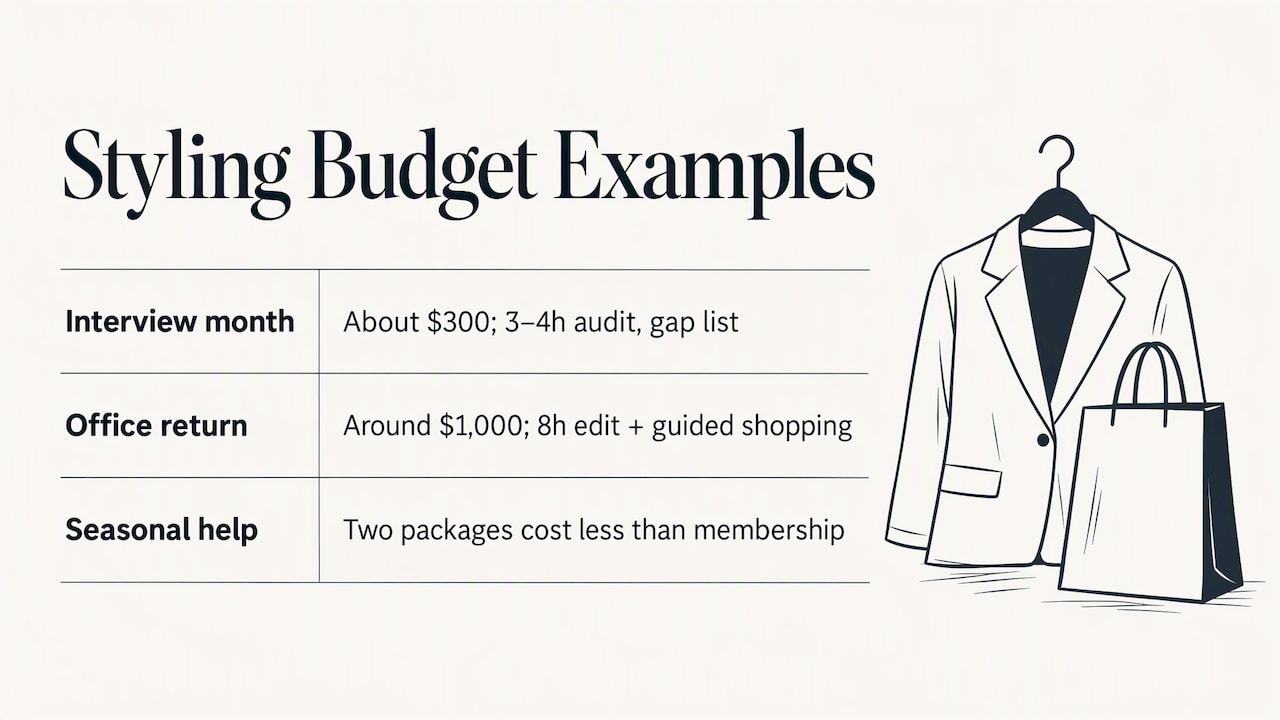
You have an interview-heavy month and about $300. A single three- or four-hour consultation focused on a closet audit and a short list of gaps is realistic in many markets. Go in with photos of what you own and one clear goal, such as five work outfits, and you will use every hour.
You are returning to an office after years away and have around $1,000. An eight-hour package split across a closet edit and one guided shopping session is a common structure. Ask the stylist to leave you with a written list of the outfits you built, so the value outlasts the visit.
You want help every season. A retainer makes sense only if you will really use it. If you would book a stylist twice a year, buying two separate packages usually costs less than a membership.
Is a personal stylist worth it?
It depends on what problem you are trying to solve. A stylist is most worthwhile when you need efficient decision-making, a closet audit, outfit systems, or help through a major change, such as a new career, a body change or a move. It is a weaker buy if what you want is simply more shopping.
There is clearly demand for the idea and resistance to the price. A survey reported by Verily found that one in two women felt their lives would be easier with a personal stylist, yet 82.8% would not spend $1,000 on one. That gap is the reason cheaper, more structured options are growing. The survey is from 2019, so treat it as a signal, not a current measurement.
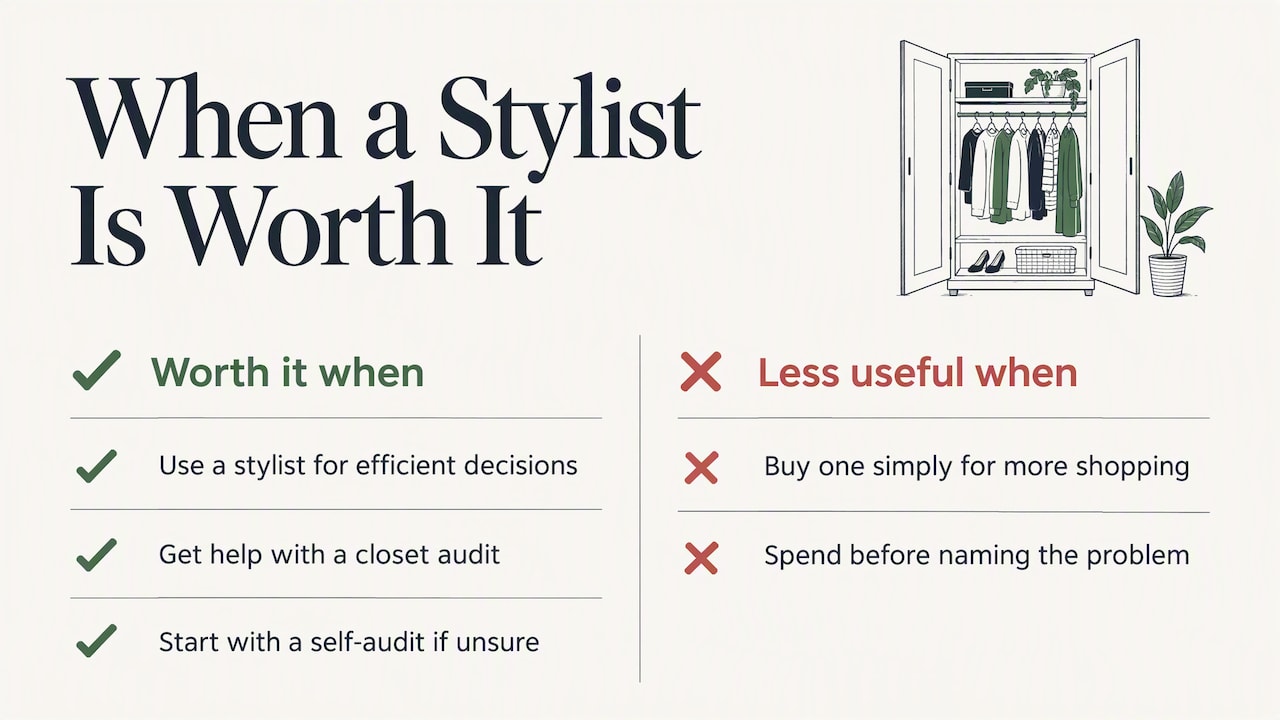
A simple test: if you could name, today, what is going wrong (nothing to wear despite a full closet, too many pieces that do not combine, shopping that never fills the same gap), then a few hours with a stylist or a good system can fix it. If you cannot name it, start with a self-audit before you spend anything.
How to spend less without losing the benefit
- Do the sorting yourself first. Pull out everything you have not worn in a year. Paying a stylist to watch you try on clothes you already know do not work is expensive.
- Book a defined task. “Build seven work outfits from my closet” costs less and delivers more than an open-ended session.
- Use free retailer advice for buying decisions. If you already know where you shop, free in-store or online styling can help with fit and sizing. Keep it to that.
- Plan your week. Much of what people pay a stylist for is a repeatable routine. Our guide to weekly outfit planning walks through a system you can start tonight.
- Shop secondhand with a plan. Consignment can stretch a budget, especially for workwear. See how to shop consignment like a stylist.
- Copy formulas. Our outfit formulas show 12 looks you can build from a typical closet.
Our perspective: where a stylist’s money goes
We have spent more than 20 years styling women in person, and the pattern is consistent. Most clients do not need more clothes. They need a clear view of what they own, a few repeatable outfit formulas, and a short, specific shopping list. That is the part of a stylist’s fee that pays off, and it is also the part that can be taught and systematized.
The expensive part of a traditional engagement is the human time spent on tasks that repeat for almost every client: photographing and sorting a closet, finding the gaps, and working out what goes with what. Those are the hours that make private styling unaffordable for many women who would benefit from it.
Our view is that a stylist is worth the money for judgment, such as a big career change, an unusual body or budget challenge, or a high-stakes event. For the everyday question of what to wear from what you already have, good tools can do a lot of the work. Wendy’s background in education is why we put so much weight on teaching you the logic behind an outfit, so the next one takes you minutes, not another appointment. You can read more in what 20+ years as a wardrobe stylist taught me about personal style.
— Wendy
Where Style To Cart fits
Style To Cart is the platform we built from those years of consultations. It lets you virtually assess your closet, spot gaps, discover new ways to wear what you already own, and shop strategically for what is actually missing. It is a subscription, not an hourly fee, so you are not watching a clock. If you are weighing a stylist mainly for closet organization and outfit planning, start at wendypilch.com and see whether the platform covers what you need. You can also read about how Wendy went from stylist to software founder.
It will not replace everything a human stylist does in person, such as hands-on tailoring decisions or a full-day shopping trip. But for the planning, organizing and gap-finding that fills most of a typical stylist’s hours, it is built to give you the same method at a scale that fits a normal budget.
A quick checklist before you book anyone
- Write down the one outcome you want, in a sentence.
- Photograph your closet and your five most-worn outfits.
- Set a ceiling in dollars and a ceiling in hours.
- Ask each stylist for written deliverables and what is billed on top of the hourly rate.
- Ask for a past client reference or before-and-after examples.
- Decide in advance what you will do if the session ends and you still feel stuck.
If your goal is work-specific, our guides to the five-minute work wardrobe and meeting outfits for women show what a stylist would likely cover in a first session, so you can tackle part of it before you pay.
FAQ
How much is a personal stylist per hour?
Most independent stylists charge roughly $100 to $300 an hour, with some online services starting lower and top specialists charging more. New York and Los Angeles sit at the high end. Rates depend on city, experience and the number of hours you buy.
How much does a stylist cost for four hours?
A realistic benchmark is a few hundred dollars, with one widely published example at about $320 for a closet audit, outfit planning and a shopping plan. Premium stylists in big cities can charge considerably more. Ask whether preparation, travel and written outfit plans are inside those four hours.
Is hiring a personal stylist worth it?
It is worth it when you have a specific problem: a closet full of clothes you do not wear, a career change, or a lot of decisions to make quickly. It is less worth it if you mainly want to buy more clothes. A stylist who works from your existing wardrobe can reduce unnecessary purchases.
Is there a cheaper alternative to a personal stylist?
Yes. Retailer styling can be free or low-cost, box subscriptions are inexpensive and convenient, and digital tools like ours help you organize your closet and plan outfits for a subscription fee. Each trades some personalization for price, so match the option to your goal.
What is the 70/30 rule for wardrobe?
It is a loose guideline, not an official rule, usually meaning about 70% reliable basics and 30% trend or statement pieces. Stylists use versions of it to keep a closet wearable. Adjust the ratio to your job and lifestyle.
Sources
- Trade coverage of in-home retail styling services (Glossy, 2019)
- Stitch Fix review (Wirecutter, 2019)
- Wardrobe stress and personal stylist survey (Verily, 2019)
Recommended
About Wendy
Wendy Pilch is an award-winning wardrobe stylist, entrepreneur and Founder & CEO of Style To Cart. After more than 20 years of helping women build wardrobes and define their personal style, Wendy is bringing that experience to fashion technology.