Cost Per Wear: How to Calculate It and Use It Well

Cost per wear (CPW) is what you paid for a piece of clothing divided by the number of times you wear it. A $100 jacket worn once costs $100 per wear. Worn 50 times, it costs $2. That is the whole formula, and the useful part is knowing which numbers to put into it, when to trust the result, and when it quietly misleads you.
Below you will find the math, worked examples, a realistic way to judge a “good” number, the two corrections that make CPW honest, and a simple way to track it without a spreadsheet becoming a second job.
TL;DR
- Cost per wear = purchase price ÷ number of wears. Add tailoring and care to the price, and subtract what you could realistically resell the piece for.
- There is no universal “good” number. Compare like with like: a coat against a coat, sneakers against sneakers, and your actual wears against your honest forecast.
- CPW is most useful as an audit of what you already own. Used before a purchase, it is easy to bend into an excuse.
- Track the date you wear things for one season and you will see which pieces earn their place and which only take up hangers.
Table of Contents
- What cost per wear actually measures
- How to calculate cost per wear
- Why cheaper does not always win
- Resale changes the math
- What counts as a good cost per wear?
- Where cost per wear goes wrong
- Care extends wears
- How to track cost per wear without it becoming a chore
- Our perspective
- Let your closet do the math
- Putting it together: a worked example
- FAQ
- Sources
What cost per wear actually measures
A price tag tells you what a garment costs on the day you buy it. Cost per wear tells you what it costs to own and use. That shift matters because shoppers are changing how they judge value: AP reporting on cost per wear describes consumers moving away from disposable fast fashion toward sturdier, more versatile pieces that deliver more use for the money as prices stay high.
The idea is personal. Your CPW for a blazer depends on your job, your climate, your laundry habits and how often you genuinely reach for it. Two women can buy the same blazer and end up with very different numbers. That is why a calculator alone never settles the question.
How to calculate cost per wear
The basic formula
Cost per wear = purchase price ÷ number of wears
Some examples:
| Item | Price | Wears | Cost per wear |
|---|---|---|---|
| Cotton tee | $25 | 50 | $0.50 |
| Trousers | $90 | 90 | $1.00 |
| Wool coat | $300 | 120 | $2.50 |
| Party dress | $150 | 3 | $50.00 |
These figures are illustrations, not benchmarks. The pattern is the point: the more you wear something, the less each wear costs, and the cost falls fast at first and then slowly. The first ten wears of that coat take it from $30 to $30 per wear at wear ten, then only down to $2.50 by wear 120.
Forecast versus actual
There are two versions of the calculation, and mixing them up causes most of the trouble.
- Forecast CPW uses the wears you expect before you buy. It is a guess, and people tend to guess high.
- Actual CPW uses the wears you have logged. It is a fact, and it is the version worth trusting.
A useful habit is to write your forecast down at purchase, then compare it with the real count after a season. The gap tells you something about your own shopping patterns that no formula can.
Two corrections that make it honest
The plain formula flatters expensive items and ignores what happens after you buy. Two adjustments fix that.
1. Add what it costs to keep the piece wearable. Tailoring, dry cleaning, shoe repair and similar costs belong in the total. A wardrobe cost calculator lets you enter tailoring, care and resale value alongside the price, which is the right instinct: a $200 dress that needs $40 of hemming and cleaning is a $240 dress.
2. Subtract what you can realistically get back. That Velvet Lady argues that subtracting resale value, along with a second correction, turns CPW from a rationalization into a decision tool. If a coat will resell for a meaningful share of its price, its true cost is lower than the tag suggests.
The corrected formula looks like this:
(Price + tailoring and care − realistic resale value) ÷ wears
Why cheaper does not always win
The standard formula can point you the wrong way. Lady Lives gives a clear example: a $60 blazer worn 40 times costs $1.50 a wear, while a $228 blazer worn 144 times costs $1.58. By the plain math, the cheap one wins. But the more expensive blazer was worn more than three times as often, which says something the ratio hides: you reached for it because it fit, looked right and worked with the rest of your closet.
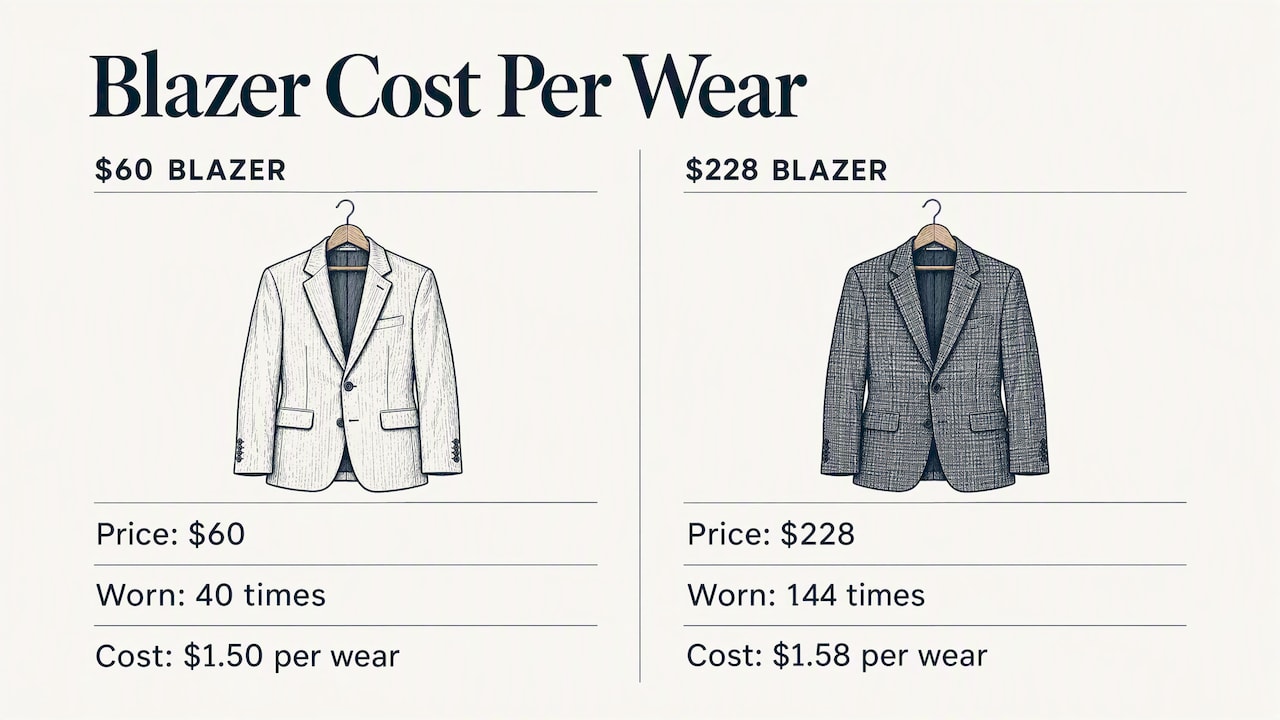
CPW tells you cost, not satisfaction. A piece that is cheap per wear but that you never feel good in is still a poor buy, because the wears you did get came with a compromise. And a piece with a slightly higher number that you love may be the better one.
Resale changes the math
Secondhand has become part of how shoppers think about value. According to Forbes’ analysis of resale, secondhand fashion sales reached $55.5 billion in 2025, about 12% of U.S. spending on clothing, footwear and accessories, and the resale market is growing four times faster than the primary market.
That has a practical consequence for CPW. A piece you can sell later costs you less in the end. The caution, from the same Lady Lives piece, is to judge resale by sold listings, not asking prices, on platforms such as Poshmark. A brand or silhouette that actually sells recovers value. One that merely sits in listings does not.
If you shop secondhand yourself, our guide to shopping consignment like a stylist covers how to spot pieces worth the price.
What counts as a good cost per wear?
Readers ask this constantly, and the honest answer is that it depends on the category. A few ways to think about it:
- Compare within a category. A $3 CPW is poor for a T-shirt and excellent for a formal coat. Judge a piece against what similar items typically cost you per wear.
- Set a target before you shop. Decide, for example, that your work trousers should land under $2 per wear, then ask whether you will realistically wear them enough to get there.
- Count the wears you can really picture. If you cannot name three outfits you would make with it, the forecast is optimistic.
- Allow occasion pieces to be expensive. A dress for one wedding will have a high CPW. That is fine when it is a deliberate choice rather than a surprise.
And for the question many people search next, whether $500 is a lot to spend on clothes: the amount matters less than the wears behind it. $500 spent on five pieces you wear weekly for years is a different decision from $500 spent on one trend piece worn twice.
Where cost per wear goes wrong
CPW is easy to misuse, and it is worth naming the traps.
The justification trap. “It’s only $2 a wear if I wear it 100 times” can justify nearly any purchase. The most careful practitioners, as Lady Lives notes, use CPW to find wardrobe gaps rather than to excuse impulse buys. If you are using the formula to talk yourself into something, stop and ask what you already own that does the same job.
The duplicate trap. A fifth black cardigan has a low forecast CPW and a high real one, because it splits wears with the other four. Wears are not free-floating; they are shared among similar pieces.
The one-number trap. A low CPW on an item that no longer fits, or that you only wear around the house, is not a win.
The forgotten-cost trap. High-maintenance fabrics, specialty cleaning and frequent repairs all push the real number up.
Care extends wears
The easiest way to lower your CPW is to keep good pieces wearable longer. Washing by the label, rotating shoes, storing knitwear folded and fixing small repairs early all add wears for almost no money. Even accessories benefit: this product care page for performance hats shows the kind of upkeep that keeps an item in use for more seasons.
How to track cost per wear without it becoming a chore
Most people give up on tracking because it feels like homework. A lighter approach works better.
- Start with what you own, not what you buy. Pick one category, such as tops or shoes, so the job feels finite.
- Log price and date, roughly. An approximate price is fine. If you do not remember, estimate and mark it as an estimate.
- Record wears for one season. A note on your phone, a tally in a spreadsheet, or a photo of each day’s outfit will do. Do not try to reconstruct the past.
- Sort by the result. At the end of the season, rank pieces by wears. The top of the list shows your real uniform. The bottom shows what you bought for a life you are not living.
- Act on it. Move the bottom group to a “try or release” pile. Style each piece three new ways before you decide, and sell or donate what still does not work.
This audit is where CPW pays off most. It costs nothing, it uses numbers you generate yourself, and it points straight at gaps and duplicates. Our work wardrobe method pairs well with it if mornings are your pain point.
Our perspective
We have spent more than 20 years styling real women’s closets, and the same pattern shows up again and again. The problem is rarely that a client owns too little. It is that she owns plenty she does not wear, and keeps buying to fill a hole that is really a styling hole.
Cost per wear is a useful lens for that, as long as you point it backward. We would rather you use it on the closet you have than on the cart you are holding. When a client sees that a $180 pair of trousers has been worn four times, the conversation changes from “I need something new” to “what is stopping me from wearing these?” The answer is usually a missing top, a shoe that does not work, or simply no one ever showed her how to put the outfit together.
That is why we think the best CPW strategy is not a formula. It is a short list of pieces you genuinely love, a clear idea of the gaps, and a plan for how each new item works with at least three things you already own. Our wish list method is built on exactly that idea. Buy slowly, buy for the gap, wear what you buy.
Numbers help you see. They do not replace knowing your own style, which is what makes a piece wearable year after year.
— Wendy
Let your closet do the math
Style To Cart is a fashion technology platform that grew out of Wendy Pilch’s styling consultations. It lets you assess your closet virtually, find gaps, discover new ways to wear what you already own, and shop with a plan. If you would rather see what is working in your wardrobe than tally wears by hand, start at wendypilch.com, or read how Wendy went from stylist to software founder.
Putting it together: a worked example
Say you are deciding between two coats for the winter.
- Coat A: $140, you expect to wear it 30 times over two winters, resale value about $20, no extra care costs.
- Coat B: $320, you expect 80 wears over four winters, $30 for cleaning over that time, realistic resale value $100 based on sold listings for the brand.
Plain CPW gives Coat A $4.67 and Coat B $4.00. With the corrections, Coat A is ($140 − $20) ÷ 30 = $4.00, and Coat B is ($320 + $30 − $100) ÷ 80 = about $3.13. These are hypothetical numbers, but notice what happened: the gap widened in favor of the pricier coat once resale and care were counted, and the result depends entirely on the 80-wear forecast being honest.
So the last question is the one the formula cannot answer: do you wear a coat 20 times a winter? If your commute is a short walk to the car, probably not, and the cheaper coat wins on realism. Run the calculation, then check it against your actual habits.
A few other tests help before buying anything:
- Can you build three outfits from pieces you already own?
- Does it fit your current life, not the one you plan to have?
- Would you buy it at full price, or only because of the markdown?
- Is there a sold-listing history if you ever want to resell?
If you answer yes to the first three, the forecast is probably sound. For help clarifying what suits you, our post on personal style after 40 is a good place to begin, and the Millennial wardrobe reset covers what is worth owning now.
FAQ
What does cost per wear mean?
It is the price of a clothing item divided by how many times you wear it. A $100 item worn 25 times costs $4 per wear. The more you wear it, the lower the number goes.
How do you calculate cost per wear?
Divide the purchase price by your number of wears. For a fuller picture, add tailoring and care costs to the price and subtract what you could realistically sell the piece for, then divide by wears.
How do I track cost per wear for the clothes I already own?
Pick one category, note each item’s approximate price, and record every wear for one season on your phone or in a spreadsheet. Rank items by wears at the end. The pieces at the bottom are your candidates to restyle, sell or donate.
Is a low cost per wear always a good sign?
No. A low number on something you wear out of habit, or that does not fit well, is not good value. CPW measures cost, not how you feel in the piece, so pair it with an honest look at fit and how often it makes your best outfits.
What is a reasonable cost per wear?
There is no single answer, because it varies by category. Compare similar items, set a target before you buy, and keep occasion pieces separate, since a special dress will always cost more per wear than a daily tee.
Sources
- AP: cost per wear and shopping under inflation
- Forbes: Resale becomes the fashion industry’s new value flywheel
- Lady Lives: Your cost per wear formula is wrong
- That Velvet Lady: Cost per wear mathematics
- Wardrobe Cost Calculator
Recommended
About Wendy
Wendy Pilch is an award-winning wardrobe stylist, entrepreneur and Founder & CEO of Style To Cart. After more than 20 years of helping women build wardrobes and define their personal style, Wendy is bringing that experience to fashion technology.