Interview Outfits for Women: What to Wear and Why
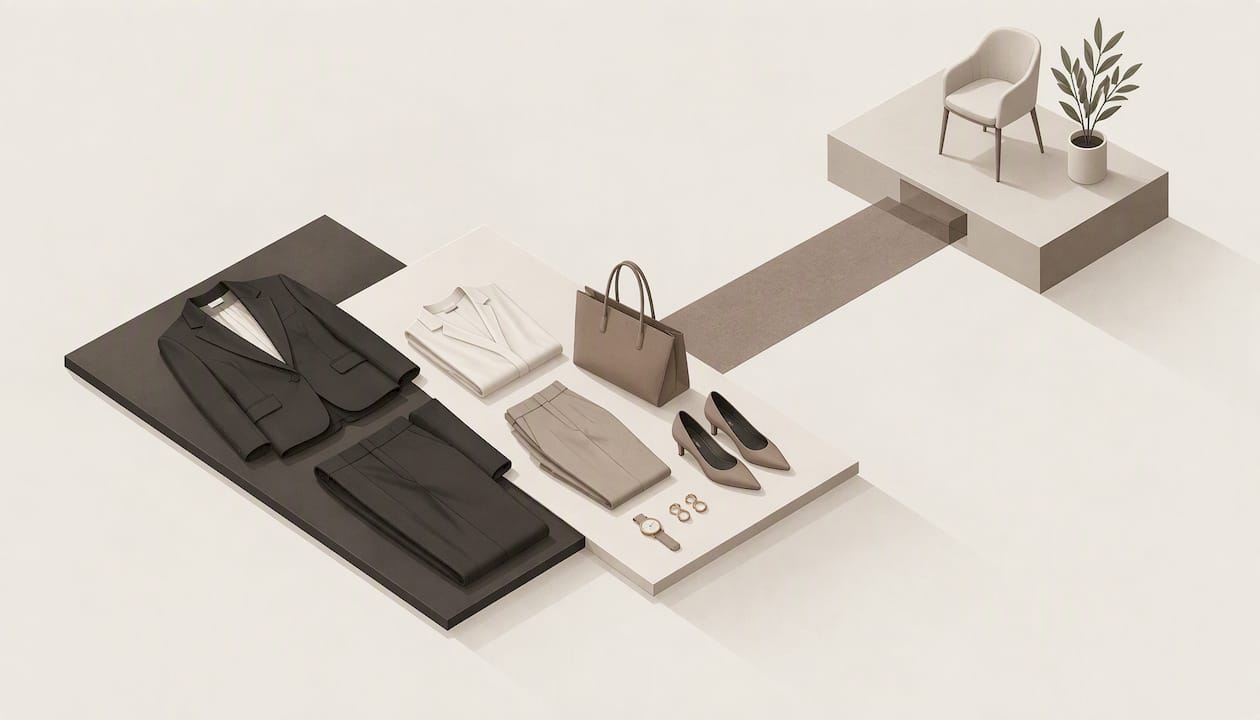
The safest interview outfit is one that matches the company’s dress code, fits you well and lets the conversation stay on your skills. For most corporate roles that means a tailored suit, a blazer with dress pants or a knee-length skirt, or a conservative dress. For creative or casual workplaces, you dial it down one notch, never several.
This guide gives you outfit formulas you can build from what you already own, a way to read any employer’s dress code, and the small details (fit, shoes, color, accessories) that decide whether an outfit looks polished or merely fine.
TL;DR
- Dress one step above what employees wear day to day. Research the company first, because a hedge fund and an art gallery expect different things.
- A tailored blazer with dress pants or a knee-length skirt, or a simple dress with a blazer, works in most corporate settings.
- Fit beats price. Anything that pulls, gaps, wrinkles or needs adjusting mid-interview will distract from your answers.
- Choose your outfit days ahead, try it on, and sit in it before the interview.
- Color is allowed. A strong shade in one piece can make you memorable without being loud.
Table of Contents
- Start with the company, not the closet
- Interview outfit formulas that work
- Fit, fabric and color: the details that carry the outfit
- Dressing for video and phone-adjacent interviews
- What to skip
- Plan the outfit, not the panic
- Our perspective: dress the role you want, from what you own
- Build your interview outfit from the closet you already have
- FAQ
- Sources
Start with the company, not the closet
The most common mistake is picking an outfit before learning what the workplace looks like. An employment and personal-development coach quoted in The New York Times advises researching the employer’s culture online or in person, and points out that a hedge fund has different clothing expectations than an art gallery. That is the whole method in one sentence.
Here is how to do that research in about twenty minutes:
- Look at the company’s team page and social accounts. What are employees wearing in photos? Blazers and button-downs, or knits and sneakers?
- Check recent event photos or office tours. Careers pages often show real days at work.
- Read the interview invitation. Some recruiters mention dress code outright. If yours does not, it is perfectly fine to ask the recruiter or coordinator.
- Visit in person if it is easy. Watching people walk in at 9 a.m. tells you more than any article.
Then go one step up. If the team wears jeans and a nice top, you wear tailored trousers and a blazer. If the team wears business casual, you wear business formal or a polished version of it. Being slightly overdressed reads as respect. Being underdressed reads as not having prepared.
Interview outfit formulas that work
You do not need a new wardrobe. You need a few reliable combinations. Use this table as a starting point, then adjust for the company.
| Setting | Outfit formula | Shoes | Keep it simple |
|---|---|---|---|
| Corporate (law, finance, consulting, government) | Matching suit with pants or a knee-length skirt, plain blouse or shell | Closed-toe pumps or polished flats | Neutral colors: navy, charcoal, black, gray |
| Business casual (most offices) | Blazer, dress pants or a midi skirt, blouse or fine-gauge knit | Loafers, flats or low block heels | One accent color at most |
| Creative or startup | Tailored trousers or a structured skirt, a refined top, a blazer or cardigan | Clean leather sneakers only if the culture clearly allows them, otherwise loafers or flats | A statement piece, not three |
| Trades, healthcare, retail, hospitality | Nice blouse or shirt with trousers or a skirt, clean and pressed | Comfortable closed-toe shoes | Practical and neat, no heavy jewelry |
| Dress-forward | Knee-length sheath or A-line dress with a blazer | Closed-toe pumps or flats | Check the hem when you sit down |
The pairing in each row is not a rulebook. It is a shape: structured on top, clean lines below, closed-toe shoes, minimal accessories.
Corporate and conservative fields
Career centers are consistent here. Emmanuel College’s career center lists a suit with a knee-length skirt or dress pants as appropriate for women in corporate positions. Forbes Vetted’s guide names a tailored, well-fitting suit and a conservative dress as two excellent choices, and says the aim is polished, purposeful choices that do not distract from your credentials.
If you wear a suit, make sure jacket and bottoms come from the same fabric and dye lot. A mismatched black can look obvious in daylight. If your pieces do not match exactly, make it a deliberate contrast, such as a navy blazer with gray trousers, rather than a near miss.
Business casual and creative workplaces
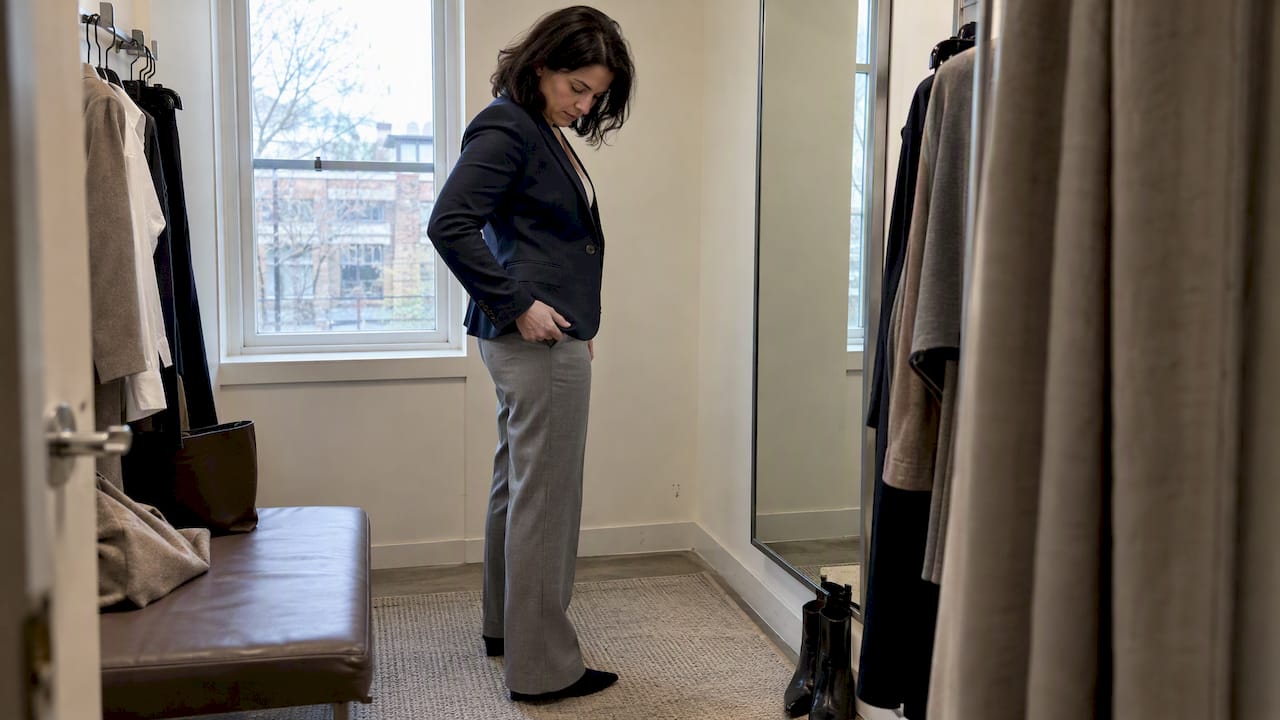
Business casual is where most people get stuck, because the range is wide. A reliable formula is a blazer, a blouse or fine knit, and tailored pants, finished with loafers or flats. The U.S. Department of Labor’s interview skills guide tells candidates to consider the norms of the industry and suggests something more casual for creative fields, and a nice shirt or blouse with trousers or a skirt for the trades.
“More casual” still means intentional. Think fitted, pressed and clean, not worn-in. A creative director will notice a wrinkled shirt as quickly as a banker would.
The dress question
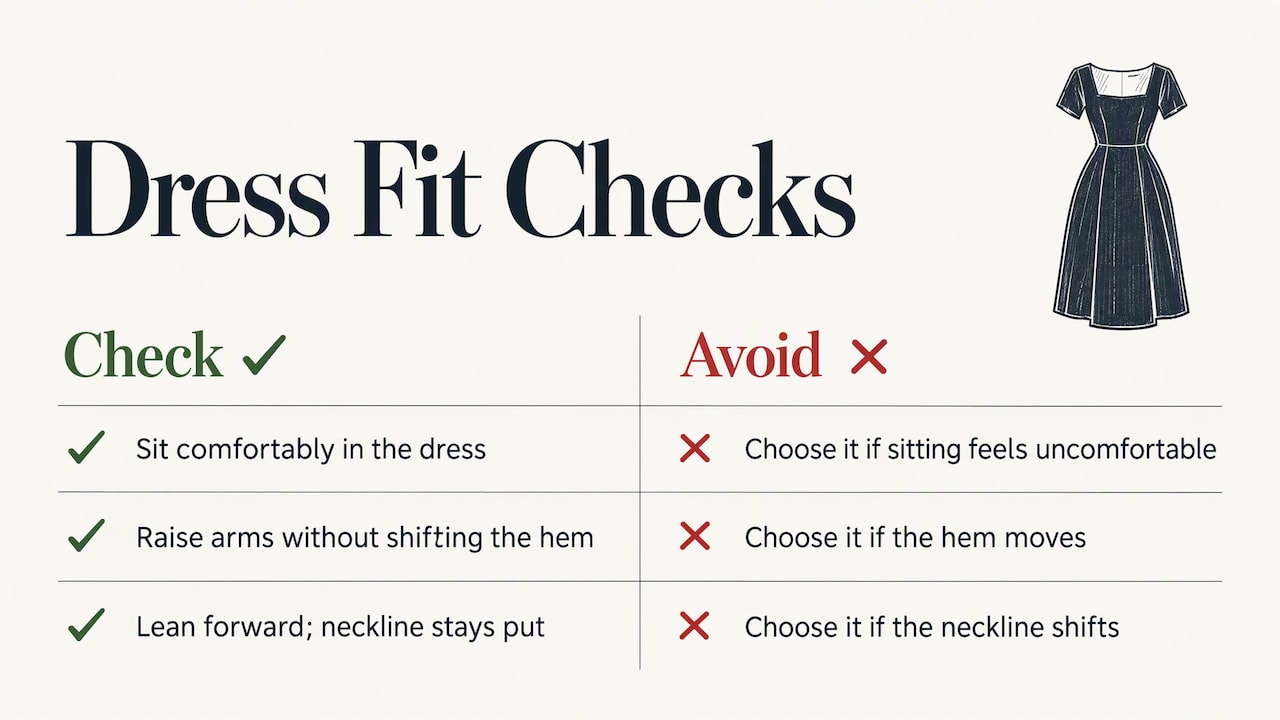
A dress is a good interview choice because it is one decision instead of three. Choose a knee-length or midi cut in a structured fabric such as crepe, ponte or heavier cotton, with sleeves or a blazer over it. Check three things before you commit: can you sit comfortably, can you raise your arms without the hem moving, and does the neckline stay put when you lean forward? If the answer to any of them is no, pick something else.
Fit, fabric and color: the details that carry the outfit
Fit
Fit is the single biggest upgrade. A moderately priced blazer that sits at the shoulder and closes without pulling looks better than an expensive one that does not. Check these points in a mirror, then again while seated:
- Shoulder seams sit at the edge of your shoulders.
- Buttons close without creasing across the bust or waist.
- Pants break at the top of your shoe, with no puddling at the ankle.
- Skirt hems stay near the knee when you sit.
- Nothing gapes between buttons.
A tailor can fix hems and nip waists inexpensively compared with buying new, so a near-perfect piece you already own is often worth alterations.
Fabric
Choose fabrics that hold their shape: wool blends, crepe, ponte, structured cotton. Avoid very thin or sheer fabrics, stiff pieces that crease at the elbow, and anything that clings. Steam or iron the night before. Wrinkles are the quickest way to undo a good outfit.
Color
Navy, black, charcoal, gray, camel and cream are the dependable base. But a suit does not have to be dull. In the New York Times fashion column, Harper’s Bazaar editor Samira Nasr suggests leaning in to color. In practice, that means one confident shade, such as a deep green blouse under a navy blazer, a burgundy knit, or a cobalt shell. Keep the rest neutral and the outfit looks deliberate.
Shoes, bags and accessories
- Shoes: Closed-toe, clean and comfortable enough to walk a long hallway in. Scuffed heels are noticed. Heel height matters less than whether you walk confidently.
- Bag: One structured tote or bag that holds printed copies of your résumé, a notebook and a pen. The World Bank’s interview guide recommends packing your materials ahead, such as résumé copies, a portfolio or writing samples.
- Jewelry: Small earrings, a simple necklace or watch. Skip anything that jingles when you gesture.
- Scent and nails: Go light on fragrance, and keep nails neat. These are small and easy to forget.
Dressing for video and phone-adjacent interviews
Virtual interviews have their own rules, because the camera frames you from the chest up. Dress fully anyway, including the bottom half, since you may need to stand up or move. Some practical points:
- Choose solid colors that contrast with your background. Busy patterns and tiny stripes can shimmer on camera.
- Test your outfit on a video call beforehand, in the same light you will use for the interview.
- Avoid very bright white near your face if your camera overexposes. Soft off-white or a mid-tone color tends to look better.
- Keep jewelry quiet so it does not clink against a desk or a headset.
- Sit down in the outfit and check the neckline and collar in the frame.
What to skip
Polished does not mean strict. It means nothing in the outfit competes with you. These are the usual culprits:
- Anything you need to adjust. Short skirts, plunging necklines, loose straps and slippery fabrics all pull your attention away from the conversation.
- Sheer or tight pieces. If you wonder whether it is too transparent, it is.
- Heavy fragrance or noisy jewelry. Interview rooms are small.
- Brand-new shoes you have never walked in. Blisters are real.
- Wrinkled or pilled fabric. Check under bright light, not in your bedroom.
- Overdoing the trendy piece. One current item is fine. A whole outfit of trends can date quickly and may not suit the employer.
The previous list is not about modesty. It is about eliminating distractions, which matches Forbes Vetted’s advice to keep choices purposeful.
Plan the outfit, not the panic
The World Bank guide recommends deciding your interview outfit in advance rather than the night before, and arriving about 15 minutes early. Here is a simple timeline that builds on that:
- Three to five days before: Research the dress code and choose two outfit options.
- Two days before: Try both on, sit, walk, raise your arms. Pick one. Send anything that needs it to the cleaners or tailor.
- The day before: Steam or iron. Lay out shoes, bag and accessories. Pack copies of your résumé.
- Interview morning: Dress, check the mirror for lint and loose threads, and leave with time to spare for traffic.
If your first-choice piece fails the try-on, you still have time to swap it. That is the entire point of starting early.
Our perspective: dress the role you want, from what you own
After more than 20 years of working with women on their wardrobes, we see the same pattern. The woman who struggles before an interview rarely lacks clothes. She lacks a clear picture of what she already owns and what is missing. She buys a new outfit in a panic, wears it once, and it joins the pieces that never get worn.
Our advice is to start from the closet. Lay out every blazer, pair of trousers, skirt, blouse and dress you own. Ask which pieces fit well, which feel like you at your most capable, and which can be combined at least three ways. Often there is a complete interview outfit already there, and what is missing is one piece, such as a well-cut blazer or a neutral shoe. Buying that single piece is strategic shopping. Buying a whole outfit is a guess.
We also encourage women to treat the interview outfit as part of a bigger system. A blazer that works for an interview works for presentations, client meetings and the first week at the new job. If you choose with that in mind, you invest in pieces that return value many times. And choose clothes that let you forget about them. The best interview outfit is one you stop thinking about once you walk in.
— Wendy
Build your interview outfit from the closet you already have
If you want help seeing what you own, finding the gaps and working out new ways to wear existing pieces, that is what Style To Cart is built for. It is a fashion technology platform that brings Wendy Pilch’s wardrobe styling experience into software, so you can assess your closet virtually, plan outfits and shop for what is actually missing instead of what looks good on a mannequin. You can also read about how Wendy went from stylist to software founder, and find more styling advice on The Edit.
FAQ
What should women wear to a job interview?
For most office roles, a tailored blazer with dress pants or a knee-length skirt, or a conservative dress with a blazer, is a safe choice. Wear solid, structured pieces in neutral colors, closed-toe shoes and minimal accessories. Then adjust up or down based on what employees at the company wear.
Is it okay to wear a dress to an interview?
Yes, as long as it is knee-length or midi, made from a fabric that holds its shape and comfortable when you sit. Adding a blazer or cardigan makes it look more formal and covers bare arms in conservative settings. Test it seated before the day.
Can I wear color to an interview?
Yes. Harper’s Bazaar’s editor, quoted by The New York Times, encourages leaning in to color rather than defaulting to a boring suit. Keep it to one standout piece and let the rest be neutral. Choose a shade that flatters you and is not distracting on camera.
What if I do not know the company’s dress code?
Check employee photos on the company’s website and social channels, or ask the recruiter. If you cannot find out, choose business casual at its most polished: blazer, tailored pants or skirt, and a simple top. It is appropriate almost everywhere. For the sources of those norms, see Penn State Engineering’s career guidance, which advises students to buy professionally appropriate attire for employer interactions.
Do I need to buy a new outfit?
Not necessarily. If something you own fits well, is pressed and suits the workplace, wear it. Buy only to fill a specific gap, such as a blazer or a neutral pair of shoes, and try everything on days ahead.
Sources
- What Can I Wear to a Job Interview Besides a Boring Suit? (The New York Times, 2025)
- How to Dress for a Job Interview (The New York Times, 2020)
- TEAMS Interview Skills Participant Guide (U.S. Department of Labor)
- World Bank Group interview guide
- What To Wear To An Interview (Forbes Vetted)
- Dress for Success: The Dos and Don’ts of Job Interview Attire (Emmanuel College Career Center)
- Dress for Success (Penn State Engineering Career Services)
About Wendy
Wendy Pilch is an award-winning wardrobe stylist, entrepreneur and Founder & CEO of Style To Cart. After more than 20 years of helping women build wardrobes and define their personal style, Wendy is bringing that experience to fashion technology.